Showing posts with label UK’s Motor Idols. Show all posts

Tuesday, 15 May 2012

UK’s motor vanity fair (26) [Bâlciul deşertăciunilor cu motor din UK]

Again, I find no point in saying much; here’s another extremely interesting spyder photographed by my reader C.L., which was parked to the left side of this one.

To my great surprise, quite soon after I had posted the previous episode of this series, someone correctly identified the car brand. Would this happen again?

I couldn’t identify the symbol on the – let’s thank Wikipedia for the short English lesson! :-) – bonnet ornament (or radiator cap or motor mascot or car mascot) in the pic.

[For all the episodes of this series, and all the posts on this blog go to/Pentru toate episoadele din această serie şi toate postările de pe acest blog mergi la: Contents/Cuprins]

Friday, 21 October 2011

UK’s motor vanity fair (23) [Bâlciul deşertăciunilor cu motor din UK]

Apart from a brief trip to Berlin (some pictures of it on this blog), I didn’t have the chance to know how German cars ‘fit’ into the landscape of German cities.

However, I must say that they surely fit on the streets of an elegant British city like Edinburgh  where I saw hundreds of them and I wish I knew why most were either black or grey?! :-)

While even an iconic brand like the Mini is produced under German management (+ technical leadership, I presume), there’s no doubt that Brits love German cars.

Just like Americans who – irrespective of their patriotism requiring them to give a helping hand to their national car manufactures – keep buying German and Japanese brands.

The same ‘love story’ between motorists and German cars can be witnessed in Eastern Europe, although, with some typically ‘Oriental’ features.

In several countries neighbouring the EU, these cars are stolen from richer countries like some men used to kidnap their wives some no longer than a century or so ago.

Then, most of these cars are second hand vehicles, nevertheless, sometimes considered better than brand new cars like Dacia.

And there’s one more peculiarity of these cars – they are quite often driven by a particularly kind of people, the ‘manelists’, devout listeners of ‘manele’.

[For all the episodes of this series, and all the posts on this blog go to/Pentru toate episoadele din această serie şi toate postările de pe acest blog mergi la: Contents/Cuprins]

Friday, 8 July 2011

[EN] No comment / [RO] Fără comentarii (12) – To speed and to die / A goni şi a muri


[EN] An interesting photographic metaphor of my reader C.L., whether it was taken on purpuse or not: [RO] O interesantă metaforă fotografică a cititoarei mele C.L., fie că a fost făcută intenţionat sau nu:

[EN] Sports cars (worth at least £ 50,000 each, I guess) next to a graveyard. [RO] Maşini sport (valorând măcar £ 50,000 fiecare, socot eu) lângă un cimitir.

[EN] This is the final destination of excessive speed, as well as that of vanity, ambition, earthly dreams,  pleasures… [RO] Aceasta este destinaţia finală a vitezei excesive, precum şi a vanităţii, ambiţiei, viselor pământeşti, plăcerilor…

[For all the episodes of this series, and all the posts on this blog go to/Pentru toate episoadele din această serie şi toate postările de pe acest blog mergi la: Contents/Cuprins]

Thursday, 16 June 2011

UK’s motor vanity fair (22) [Bâlciul deşertăciunilor cu motor din UK]

It goes well with exclusive golf courses, with luxurious mansions, with holding stocks or a top management position in the banking industry, with nobiliary titles and generally with a “I-am-not-an-ordinary-mortal” attitude.

It’s… Aston Martin, the oldest sports car maker (1914). Another iconic brand of the UK, produced in Gaydon, Warwickshire (West Midlands, England).

Only 5,000 such vehicles were sold in the world in 2010 (down from a peak of 7,300 cars in 2007) yet, despite problems of other British car manufacturers and the entire global automotive industry, the company is thriving.

As the economic crisis makes billions of people poorer, the few prospective buyers get richer, so that Aston Martin expects that 25% of its sales will come from Asia by 2016.

[For all the episodes of this series, and all the posts on this blog go to/Pentru toate episoadele din această serie şi toate postările de pe acest blog mergi la: Contents/Cuprins]

Sunday, 16 January 2011

UK’s motor vanity fair (20) [Bâlciul deşertăciunilor cu motor din UK]

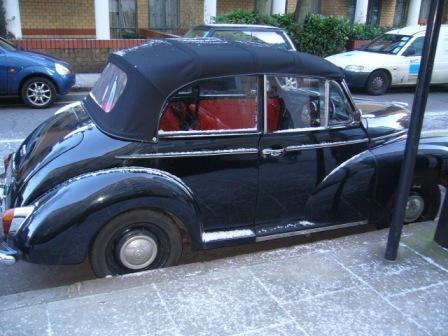
Enthusiats consider it a ‘British miracle’ and it must have been so, in 1948, when this economy car took to the British roads. Eventually, as “video killed the radio star,” so was this car of a slower-paced age killed by cars more suitable to the current maddeing faster times.

The ‘miracle’ only lasted up to 1958, when production stopped, although commercial variants kept being produced until 1971. A Total of 1,6 Morris Minor vehicles were build, but I don’t think that more than a few thousands are still in circulation.

Thanks to my reader C.L., I can add these lovely pictures of a Morris Minor to those that I took myself, and which illustrate the first episode of this series. They are glimpses of mid-20 century Britain, and offer a good example of British craftsmanship.

In the popular imagination the Morris Minor is the car of schoolmasters, district nurses, midwives, openly Anglican vicars, helpful rural grocers and men wearing hats who are, generally, not in a hurry.

If the staid institution of English afternoon tea were motorised, it would look like this. The Minor is a symbol of a gracious England unspoiled by sodium lights, bypasses, tower blocks, KFC and greedy consumerism.

This England was a fable maybe, but fables are often more interesting than facts.” – this is how The Daily Telegraph praises the car pictured here, often seen as ‘quintesentially English’ or ‘typifying Englishness’.

[For all the episodes of this series, and all the posts on this blog go to/Pentru toate episoadele din această serie şi toate postările de pe acest blog mergi la: Contents/Cuprins]

Wednesday, 1 December 2010

UK’s motor vanity fair (19) [Bâlciul deşertăciunilor cu motor din UK]

I guess it was in Brussels (in March 2008), when the idea of this blog series popped into my mind.

And it’s very likely that it was while taking the above picture of the above Mini – the Brit car that received a lot of good publicity (here or here) on this site…

…while I haven’t got any penny for that :-( Maybe it’s never too late for anything, and I could keep dreaming on :-)

And it was still in Brussels where I recently caught a glimpse of a 4-door Mini (other descriptions: here, here and here), the latest innovation of the German-British automaker.

Would this so-called ‘mini-SUV’ ever prove to at least remotely popular as the older Minis?

…or is it more likely to remain an oddity? Given the current dreadful state of the automotive industry, could anyone afford to make it a mere experiment?

[For all the episodes of this series, and all the posts on this blog go to/Pentru toate episoadele din această serie şi toate postările de pe acest blog mergi la: Contents/Cuprins]

Monday, 6 September 2010

UK’s motor vanity fair (18) [Bâlciul deşertăciunilor cu motor din UK]

I hadn’t heard anything about this Panther Kallista (made by Panther Westwinds) before going to the UK, nor have I ever seen another apart from this one, that I photographed somewhere near Trafalgar Square.

Nevertheless, I can undoubtely say that this is one of the most beautiful cars I have seen in my life, and – to my utmost surprise! – second hand versions are not prohibitely expensive.

Some evidence: £ 5, 750 (production: 1983/ mileage: 64,000); £ 6,950 (1984/78,726); £ 7,800 (1988/50,000), plus a not-so-cheap one – £ 16,500 (1979/7,100).

Like any respectable brand, Panther also has several car clubs (here, here, here), and all I can say it is pretty likeable… as an expensive toy :-)

[For all the episodes of this series, and all the posts on this blog go to/Pentru toate episoadele din această serie şi toate postările de pe acest blog mergi la: Contents/Cuprins]

Sunday, 17 January 2010

UK’s motor vanity fair (14) [Bâlciul deşertăciunilor cu motor din UK]

Irrespective of the fact that silly I don’t remember having noticed at least one Mini in the USA, the BMW-owned brand has some really good news at the beginning of this year – the US is now Mini’s best market, as the Americans have fallen in love with it.

After a year (and how many more to come?!) with bad news for the auto industry, the fact that there were 45,000 Minis sold in the US in 2009 is really amazing. Only 39,000 were sold in the UK.

Is this offering evidence that Americans are probably fed-up with American cars and not with cars in general?! Given the huge distances one has to go through even for shopping or commuting, you can’t be ‘anti-motor’ in America.

But you could get tired with the lack of imagination of the Big Three, and the Mini possibly fulfills a need for another perspective. A car mustn’t look like a typical American car in order to be a good car.

I could hardly believe that, thoughout such a bad year as 2009 has been for the whole automotive industry, mere marketing tricks could have contributed to the Mini’s success in America.

Americans probably bowed to German quality just like the Brits did: uncompromised quality, not deprived of creativity. Don’t these Mini Crossover and Mini Beachcomber look very promising?

[For all the episodes of this series, and all the posts on this blog go to/Pentru toate episoadele din această serie şi toate postările de pe acest blog mergi la: Contents/Cuprins]

Thursday, 8 January 2009

UK’s motor vanity fair (9) [Bâlciul deşertăciunilor cu motor din UK]

I’m dedicating this first blog post of 2009 to a not-so-new piece of news, but one that will keep recurring in 2009 – the car industry in the UK (as well as anywhere else in the world) is in dire straits or, quite probably, in its death throes.

In my view, irrespective of the current economic crisis (see more about this specific industry’s decline in 2008), the automakers’ problems are simply well-deserved, and it was about time that they started dying.

Obviously, no one could be happy about this bad news, nor remain unsensitive to the social aspect of this issue (the hundred thousand workers that are to remain jobless throughout the EU and the US), nevertheless, this industry is doomed – maybe not necessarily to extinction, but at least to a serious reduction in size.

In the UK, some of the darkest clouds seem to be gathering (like in the first picture) above the iconic brand Jaguar (another true ‘motor idol’ for many), as the rescue’ effort of Tata Motors (the company’s owner since March 2008) proves to have been futile.

The Indian takeover only delayed the outbreak of current problems, but it couldn’t avoid them on the long term – see about it: here or here.

Apart from central London – where, thanks to the Congestion Charge, it’s a delight to see few cars – other UK cities seem to have plenty of cars. Maybe traffic is far more civilised than in Bucharest, and streets don’t seem to be suffocated with motor vehicles like those of the Romanian capital, however, the Brits have too many cars as all the civilised (?!) nations of the EU do.

Many people are mourning for the presumably unjust death of the car industry, but I am wondering how much longer could anyone imagine its survival to be.

People don’t change even TV sets or refrigerators every couple of years, let alone their cars, yet millions of new cars get produced every year. How many more vehicles can this civilised (?!) world take? Aren’t there far too many already?

Isn’t this EU overwhelmed with cars? In the 25 EU countries of 2004, there were no less than 216 million passenger cars, let aside vans, trucks, buses, tractors, fire fighter cars, and other special vehicles… And these four years old figures are not taking into consideration the 10-14 million cars (again, from relatively old data!) produced every year in Europe! Two cars for every five EU citizens is already too much in my view...

[For all the episodes of this series, and all the posts on this blog go to/Pentru toate episoadele din această serie şi toate postările de pe acest blog mergi la: Contents/Cuprins]

Saturday, 29 November 2008

UK’s motor vanity fair (8) [Bâlciul deşertăciunilor cu motor din UK]

It’s very likely that those who own cars like these don’t need to have an hourly job in a USSU store (in front of which are parked), isn’t it?

Maybe they just love the cute girls working there (about whom I’ll probably write some day) … Or is it – just like in front my former high school – that a place like the Univerity of Sussex (US) campus (where 70 to 80% of the students are girls) is a great place to show-off?

Anyway, I just wanted to illustrate what cars some students have (I've seen better ones in front of Romanian high schools), adding that this could be a proof to what someone from the univeristy has recently wrote to me – that more and more students at the US are coming from private (independent) schools.

This shouldn’t necessarily be something bad, as these people are better prepared than those coming from the crumbling public education system. What is hard to say is how much better intellectually prepared (and owning a cool car) has to do with becoming a better human being in such an atheist society like the British one is today.

I suppose that driving such cars throughout the lovely landscape of East Sussex (a bit of this wonderful part of the world on this very blog – here, or much more – here and here) should be a lovely experience.

Of course, I shouldn’t be mean and judgemental in my assumptions, but it’s sad to witness that, quite often, those who drive cars like these wouldn’t care at all about the lovely landscape and all the natural wonders that the Lord gave to this island.

God bless anyone who drives such cars to explore the beauty of the English countryside, not just to go from one pub to another, from one social event to another, and who realize that a good car is but a tool for discovering the world, not some ‘motor idol’ increasing self-confidence, a most unreliable ‘asset’ someone could count on!

[For all the episodes of this series, and all the posts on this blog go to/Pentru toate episoadele din această serie şi toate postările de pe acest blog mergi la: Contents/Cuprins]

Monday, 7 July 2008

UK’s motor vanity fair (4) [Bâlciul deşertăciunilor cu motor din UK]

Just trivial to some, interesting to a few, indifferent to most of my readers – this is how I perceive the reaction of my readership to this series. However, I will go on with it, at least to prove that I’ve really been to the UK :-) for quite some time, and that I am also able to observe (every now and then, for someone with his head in the clouds like me :-) some aspects of this passing world, no matter how much I try to keep my heart lifted into the only real world.

I thought this ‘motor folly’ that so many people of today suffer from is a good topic of debate, but until I get relevant comments on this issue (I only received one e-mail making scarce references to my series), I can only move on in the usual way – to post as many pictures as I can, and write as few words as I can, so that I won’t write too many stupid things…

So, here are other cars that the Brits seem to love – Alfa Romeo spyders. UK motorists are fussy, and have always been spoilt by manufacturers, consequently Alfa Romeo had to come up with limited editions for the UK market like many of its competitors. Again, the price range seems affordable (from £ 25,500 to £ 31,000) but are these ‘motor idols’ really worth it?!

[For all the episodes of this series, and all the posts on this blog go to/Pentru toate episoadele din această serie şi toate postările de pe acest blog mergi la: Contents/Cuprins]

Thursday, 29 May 2008

UK’s motor vanity fair (2) [Bâlciul deşertăciunilor cu motor din UK]

Maybe there is not much left ‘sacred’ in this faithless UK (here’s another view about this from today’s Daily Mail), yet – similarily to how ‘primitive’ peoples deify various objects, rocks, trees, and animals –, many ‘civilised’ Brits worship their cars.

Certainly, this is by no means only a typically British feature, as in all consumerist societies the two-seater car is probably a ‘god’ of the day. What I mean is that this religiosity surrounding the idea of having good cars, and perfect roads is somehow more obvious in the spiritually barren UK.

Like all idolatries, its rotten fruits are obvious: some men get into financial trouble to buy them, sometimes die stupidly due to overspeeding, or at the very least they are devoured by envying those who own such vehicles, while some women sleep with bald and fat men in order to take rides in car like these.

Moreover, many children are falling in love with these ‘motor idols,’ saying to themselves: ‘When I grow up, I wanna have…’, instead of saying ‘When I grow up, I wanna be…’ People everywhere are crazy about these spyders (as the Brits call them) or roadsters (as the Americans call them), and the Brits make no exception. However, it would be unfair to consider them more obsessed with motor vehicles than other nations.

Some of these most fashionable ‘motor gods’ that I witnessed on UK’s roads are two Mazda cars – MX-5, and RX-8. I was astonished to see so many of these two-seaters (especially in Scotland, the part of the UK that I visited most), but I couldn’t be sure if it was just a mere onlooker’s impression (of someone not mad about cars, who can easily jump to the wrong conclusions), therefore I had to make a little online inquiry.

And what I found out proves my initial assumption – that the UK is one of Mazda’s best markets! Ever since the eary 1990s, the Japanese company has been stubbornly pushing to conquer the British market, and their marketing strategy seems to have paid off.

Not only that I don’t know, but I don’t even care how good these cars really are. However, it seems clear to me that the price is appealing, thus making a Mazda MX-5 more affordable than a Porsche, Ferrari or Aston Martin. A price ranging from £ 18,600 to £ 21,100 looks like a tempting offer for anyone who thinks that owning cars like these is a ‘purpose’ worth struggling for in life...

[For all the episodes of this series, and all the posts on this blog go to/Pentru toate episoadele din această serie şi toate postările de pe acest blog mergi la: Contents/Cuprins]