Showing posts with label NATO. Show all posts

Sunday, 30 June 2013

Nimic nu e imposibil: Aducem Basarabia acasă! [Nothing’s impossible: Bringing Bessarabia home!]

Dacă, pe ce cale, când anume, cu ce preţ (şi plătit de cine?) va redeveni Basarabia parte a României pare la fel de imposibil de prezis precum în urmă cu 22 de ani, când devenea aşa-zis independentă Republica Moldova.

Dintre toate ipotezele, cea mai neplauzibilă este baliverna oficială a reunirii între graniţele comune ale UE şi sub umbrela NATO. De parcă românitatea are nevoie de confirmare şi de oblojire din partea vreunei entităţi suprastatale…

Mult mai important este că o armată de voluntari visează la acest ideal naţional, cu aceeaşi înflăcărare cu care, acum un secol, se visa la trecerea Carpaţilor pentru unirea cu Transilvania. Visul unui Octavian Goga şi al altora părea la fel de imposibil.

Rusia era tot uriaşă şi puternică în acest colţ de lume. Ca mereu, nimeni în Europa nu ar fi mişcat un deget pentru a repara nedreptăţile istorice suferite de alţii. Şi atunci, o bună parte din elita ţării era absorbită de bunul plac spoit sub forma unor găunoase viziuni politice.

Avem visătorii, avem atenţia stârnită (greu de crezut că or fi mulţi cei care să nu fi văzut scris, chiar şi pe la sate, “Basarabia e România” în ultimii doi ani) şi există şi o iniţiativă legislativă cetăţenească pentru care se cer semnături.

Iniţiatorii doresc o lege care să-i asimileze în bună măsură pe locuitorii Republicii Moldova cu cei ai României, să le faciliteze accesul la muncă şi studii. Pe scurt, să-i facă să se simtă cu adevărat acasă.

A dezlipi de pe aceşti oameni stigma unor cetăţeni de mâna a doua (cum erau în URSS, faţă de ruşi) sau a unor români second hand (cum sunt până azi, în România) este un pas esenţial pentru a le reda demnitatea şi libertatea de a se cunoaşte pe sine.

Astfel, le-ar fi mult mai uşor a se recunoaşte drept români (cum doar 2.2% au făcut-o la recensământul din 2004) , dar cum sunt şi ceilalţi 76.2% dintre locuitorii ţării vecine care s-au declarat moldoveni.

Nici nu e nimic greşit: n-or fi toţi românii moldoveni, dar toţi moldovenii (indiferent de care parte a Prutului, chiar şi cei de peste Nistru) sunt parte a naţiunii române!

Cu paşi mărunţi, mai întâi printr-o asemenea lege care nu pronunţă cuvântul unire – care ar isca scandal deopotrivă la Moscova, cât şi la Bruxelles sau Berlin – se va păşi către întoarcerea Basarabiei acasă.

Nici nu contează, pe termen scurt, cum se va face această unire din perspectivă politică. Peste noapte, oricând, din voia lui Dumnezeu, imperii se pot prăbuşi de parcă nici n-au fost.

Dar este vital ca românii din Republica Moldova să se simtă apreciaţi drept români, mai ales după decenii în care li s-a imprimat în mentalul colectiv tragedia părăsirii din 1940.

Aşadar, acolo unde găsiţi corturile cu inscripţiile “Semnează pentru Basarabia!” şi  “Aducem Basarabia acasă!”,  opriţi-vă şi semnaţi în favoarea legii!

Nu vă gândiţi la implicaţiile geopolitice ale gestului! Nici nu o să aţâţaţi Moscova mai tare asupra Republicii Moldova (ruşii oricum îşi urmează planurile lor), dacă semnaţi; nici nu o să-i temperaţi manevrele viclene, dacă nu veţi semna!

Nu vă bateţi capul despre cum va arăta legea sau cum, în ţara lui Vodă-Plagiatorul, chiar se va apleca cineva asupra acestei iniţiative a cetăţenilor, nici nu lăsaţi cinismul să vă roadă cu ideea “cum poate conta semnătura mea pentru unire?” sau altele!

Gândiţi-vă la ce mult puteţi schimba în bine viaţa unor oameni (întâmplător tot români) care vor putea călători mai simplu către România şi restul UE!

[Pentru toate postările de pe acest blog mergi la/For all the posts on this blog go to: Contents/Cuprins]

Thursday, 15 November 2012

The crippled giant [Gigantul infirm]

One shouldn’t have necessarily been a great military analyst to anticipate that such a moment would sooner (rather than later) come for the Perfidious Albion.

The commanders of the armed forces (depleted by budgetary cuts) seem to be shrugging their shoulders in front of David Cameron’s request to implement a no-fly zone over Syria.

Great Britain, the former superpower of the 19th and early 20th century, can’t do anything in Syria by itself, and mustering American and NATO support would take much time.

The only readily available ally would be Turkey, but imposing a Libyan scenario on Bashar al-Assad can certainly draw the ire of Russia.

Would Britain (and France?!) risk another Crimean War, when the odds of victory are so different from what they were some 160 years ago?

Assuming that the newly re-elected ‘pacifist’ at the White House agrees with Cameron’s eagerness to go to war, wouldn’t all risk turning into a Third World War?

If I were Argentina’s president these days, I’d be rubbing my hands, wishing very much to see Britain involved in Syria.

The military giant of 1982 is severely crippled, while Obama will most probably not do anything to defend the pride of the USA
’s former colonial power.

By the time (2016-2018) London gets a new aircraft carrier, it would be very unlikely for the next (Labour?!) government to promise retaking the Falkland Islands.

[For all the posts on this blog go to/Pentru toate postările de pe acest blog mergi la: Contents/Cuprins]

Wednesday, 6 June 2012

Brussels, the European capital of begging? [Bruxelles, capitala europeană a cerşetoriei?]

Far from being ugly, Brussels probably isn’t  one of the first five most beautiful European cities, nor the biggest, either in terms of area, demographics or economic strength.

Yet it is one of the most politically influent cities in the world, as capital of the EU and headquarters of NATO. Sadly, it may deserve another not-so-flattering title.

It’s a sort of secular Mecca, except for the fact that the 500 million Europeans don’t have a religious duty to visit the ‘European shrines’.

As European citizens and taxpayers, they have the right to visit the EU’s institutions, mainly the European Parliament.

On the other hand, for all those exerting political power anywhere in Europe (at national, and sometimes even local level), visiting Brussels is compulsory.

For those in charge of a government, an important municipality, a big region, governing with their backs turned on Brussels has become impossible.

Not less than 75 to 85% (+ here, here) of the laws affecting every European’s life are fully enforced (as regulations) or initiated (as directives) from Brussels.

The fact that the process of turning a proposal of the European Commission into a legislative act passes through Strasbourg one week per month is irrelevant.

Big decisions are taken in Brussels, and the world’s largest corporations, best consultancies, professional associations or NGOs are pretty aware of that. 

It appears that around 3,000 such EU Affairs interest groups spend 158 million euro per year only on communication.

But that’s the glamourous part of Brussels and a deceptive indicator of the (presumably prosperous) state of the Union.

Beyond this glorious image, there’s a less appealing one that hasn’t ever struck me in other big cities of the world.

What cannot evade the eyes of tourists (even the richest ones, travelling by limousine) in the European capital is the number of beggars and homeless people.

With the exception of Bucharest, I haven’t seen as many beggars as in Brussels anywhere else in the world.

I didn’t see that many neither in London, nor in Paris, Berlin etc, and I hardly noticed any in Washington, DC.

One wouldn’t see beggars (only protesters – but that’s a different matter) near the White House, (Washington, DC) or Buckingham Palace (London).

Nevertheless, they are omnipresent near the European Commission (pics 3, 6), the European Parliament (pic 9) and Justus Lipsius building of the EU Council (pic 1).

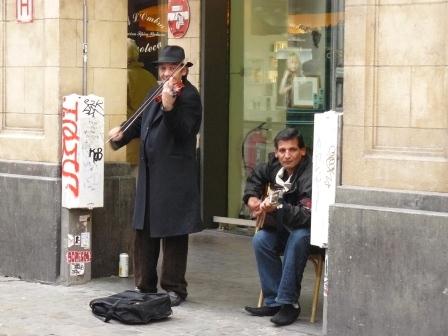
They are not the ingenious street buskers seen in other cities but relatively lousy players (= beggars) who wish to have their ‘performances’ rewarded by passersby.

As long as all important companies want to be seen in Brussels and try to have a say in the intricate EU legislative process, why wouldn’t the begging industry do the same?!

The saddest thing is that many of these destitute people – it’s arguable if begging is profitable or not – use Romanian to swear at photoholics like me :-(

[For all the posts on this blog go to/Pentru toate postările de pe acest blog mergi la: Contents/Cuprins]

Wednesday, 9 May 2012

Goodbye, rightist hypocrite! Welcome, leftist hypocrite! [La revedere, ipocrit de dreapta! Bun venit, ipocrit de stânga!]

Another swellhead hypocrite – who is convinced of having saved France as much as Gordon Clown dreamt of having saved the world – exits the stage. To no one’s surpise, not even his…

The promised surprise in the run-off election didn’t happen. Thus, Nicolas Sarkozy must step down, leaving his conterparts in the USA, EU, and NATO wondering about the future.

How and to what extent would France change under a ‘Mr Normal’ type of president, as François Hollande describes himself?

Under Sarko ‘the extravagant’, things worked out pretty well for the American (+ NATO) and German (+ EU) interests. Or, at least, everything was predictable.

On the one hand, Sarkozy indebted the country as no other before him – both as minister for Budget (1993-1995) and as President (2007-2012).

On the one other hand, he prescribed the same inane panacea – austerity. In mild doses for France, in deadly doses for Greece.

There’s nothing unusual about this hypocrisy. Excessive spending followed by excessive austerity are irrational only from the perspective of the taxpayer.

For those who decide them and their wealthy friends (from Paris or elsewhere), these apparently irreconcible policies surely have profitable reasons.

And here comes Hollande, a kind of accidental president. As lacklustre as John Kerry in the US presidential election of 2004, yet certainly luckier than him.

Dominique Strauss-Kahn’s philandering made François Hollande the new president of France. Only fanatical leftists could outline other merits of his.

As for wacky promises, he’s as good at selling them as others. He said he would tax by 75% all incomes over 1 million euros a year.

That’s second only to the 100% tax on incomes over 360,000 euros envisaged by Jean-Luc Mélenchon, the Trotskyst candidate.

It’s possible that this is but typical electoral campaign crap, however, does Hollande have any viable solutions to back up his ‘no more austerity’ slogan?!

[For all the posts on this blog go to/Pentru toate postările de pe acest blog mergi la: Contents/Cuprins]

Saturday, 3 December 2011

Will the Eurozone crack? [Va crăpa Eurozona?]

More than three years after the Wall Street Crash of 2008, the unthinkable demise of the euro and the break-up of the Eurozone has (apparently) become plausible.

It’s getting crystal clear even to the most fanatic euroenthusiasts that any imminent economic cataclysm cannot be blamed on convenient scapegoats anymore.

The lazy Greeks, the irresponsible governments in Eurozone weak links countries (PIIGS), along with greedy bankers everywhere may have played relatively secondary roles in influencing the destiny of the EMU.

Nevertheless, the fate of the European currency has never been – nor is it in these very days of turmoil – in the hands of less important actors like the above.

The devil lies in the details of EU treaties and especially in the chain of misdeeds committed by the political leaders of Europe, whether acting unilaterally, from Berlin, Paris or Rome, or together, from Brussels.

Hardly could the roots of the current crisis be located in Frankfurt, as the ECB has seldom had its hands united by the heads of state and government reunited in the Council of the Union.

More and more independent economists show that the mess engulfing the EU and threatening to blow up the global economy has systemic causes.

The EMU is on the brink of disaster because it lacks several fundamental premises of an efficient monetary union; it is made up of an econimic ‘giant’ (Germany) with 16 ‘feet of clay’ of various strengths from stronger (France) and weaker (Italy) muscles to negligible appendices (Estonia).

The ECB could be reasonably functioning as a central bank (if allowed to act do so), yet there is no effective equivalent of a national Treasury (Ministry of Finances) or Government in Brussels.

For decades, EU leaders have been deploring the lack of a common defence policy (greatly compensated by NATO) or of a common energy policy (whose absence contributes to the fact that Europeans are often ‘energy hostages’ of Russia).

It was fashionable to complain about these issues, however, none was as divisive and able to threaten the survival of the EU as the other skeleton that the current crisis took out of the Union’s closet – there is no common fiscal policy of the EMU.

In its absence, sooner or later, the Eurozone would be doomed to crack, like some analysts anticipated in the late 1990s, if not even longer before, around the dawn of this project.

The flaws of the EMU were known from the very beginning but swept under a carpet of great expectations about increased common prosperity.

For a while, the illusion worked. After the first months of wariness, when many Europeans in euro countries were shocked by price hikes, almost everyone grew accustomed with a stable currency, no need for exchange rates, low inflation and bearable interest rates.

The Greeks, Spaniards, Portuguese and others had access to cheap credit, while their tourist industries cashed in strong euros, instead of weak drachmas, pesetas or escudos.

In the meantime, the euro was weaker than how the Deutsche Mark would have probably been in the 2000s, enabling Germany to be biggest world exporter in 2007, ahead of China.

The success story seemed complete, and many warnings (like the ones about Italy being unfit for EMU membership (+ here, here, here) – see the pics*** illustrating this article!) were bluntly dismissed as nonsensical soothsaying.

Actually, there’s growing evidence that it was well-known to the architects of the euro that the Eurosystem was ill conceived from the start.

This didn’t prevent them from taking a huge gamble on the hope that a severe crisis (like the one the world has endured since 2008) would eventually help establish a “a more perfect union,” like the Constitution of the USA aimed in 1787.

Is this imperfect monetary union perfectible? Are the 17 euro countries willing to take upon themselves the full political cost of making the EMU truly functional?

And could giving up more of one country’s sovereignty guarantee anything for the EU’s citizens (“we the people,” if we were to quote the US Constitution again), apart from helping save the banking system from collapse?

Will a ‘full fiscal union’ work better than the current ailing EMU? The Eurosystem would probably run smoothly, yet the imbalances between the 17 economies would remain as grave as they are today, if not even worsen.

Smothering public deficits from the cradle would not grant choices of more responsible political leaders to European voters; it would merely ignite more vicious political battles and maybe even ‘class conflict’ within nations.

And, riskier than anything else, wouldn’t this ‘EU Treasury’ remain as unaccountable to European citizens as other EU institutions and leaders that created the current ‘euro-mess’ have always been?

[For all the posts on this blog go to/Pentru toate postările de pe acest blog mergi la: Contents/Cuprins]

*** NOTE: Simon Tilford, from the Center for European Reform (London based think-tank), warned that “if Italy fails to improve its competitiveness, it will eventually have to leave the Eurozone” (2006).

Monday, 7 November 2011

UK’s Prince of Wales, the future Charles III of Romania? [Prinţul Ţării Galilor al UK, viitorul Carol al III-lea al României?]

UK’s current Prince of Wales – let there be no room for confusion, I am refering to Charles Philip Arthur George, the first son of HM Queen Elizabeth II, father of Prince William and Prince Harry :-) – could be the future King of Romania, crowned as Charles III.

Believe it or not, this is one the hottest media topics in Romania these days! As if this country stood serenely above the economic turmoil engulfing the rest of the EU and the planet, and had plenty of time to indulge in political phantasms.

The likelihood – or imminence (?!) – of Romania’s return to monarchy under UK’s Prince of Wales has been intensely discussed in for the past ten days, since Romania’s former King, Mihai I, gave a speech in the Romanian (republican!) Parliament.

As long as Greece’s Prime Minister appears to have gone crazy, hordes of lunatics think of themselves as ‘occupying’ New York City’s Wall Street, and all sorts of nobodies get the chance to have their meteoric planetary celebrity (as defined by Andy Warhol) in our times,  why would the idea of a Romanian King of British stock sound preposterous?

Not only that the idea itself is not crazier than the mad times we are going through; the sly disseminators and the (maybe not so wise :-) supporters of this political Utopia have many (albeit illusory) arguments to feed the debate.

First and foremost, they invoke Prince Charles’ great fondness for Romania and especially for Transylvania (of which I’ve already written on this blog).

There’s hardly any doubt that His Royal Highness (HRH) is passionate about these lands, although, like it sits well with all blue-blooded characters, he’s interested in a lot of other things (I listed many of his interests in a comment to this post).

He’s a relentless supporter of Romania, and – compared to the image of Romanian political leaders, seen as corrupt, self-interested and rapacious traitors – Prince Charles benefits from a Messianic allure.

What if he could mend the broken political establishment of Romania? Couldn’t HRM put out all petty disputes, call to order the daily ‘political circus’, and unite the catastrophically disuntited and depressively disgruntled Romanians around his throne?

What if he could restore the dignity of a nation so badly seen among the other 26 EU or 27 NATO ‘sisters’?

What if, under his supposedly enlightened reign, Romania could be reunited with (the Republic of) Moldova, in defiance of Russia, our archenemy?

This is what some (I don’t know how many) ‘fans’ of Charles (and of the whole monarchic Utopia) could think, claiming that he deserves to be king more than any of the presidents of Romania had deserved their title.

Reading the (pretty long – thus apparently well documented :-) original article on this ‘Charles III issue’ can be an interesting intelectual experience, offering some valuable insights on how Romanians are.

Maybe only one article (nor the scores of opinion columns about it) couldn’t prove how mad and how feasible this Utopia is. However, given these completely insane times, no one should believe that the unthinkable will forevermore remain impossible.

Anyway, let us always bear in mind a witty bit about Romania (already shared with my Romanian readership) that I have learned in the UK from a keen observer of Romanian realities:

“If rumours and conspiracies could be exported, Romania would be the richest country in the world.”

[For all the posts on this blog go to/Pentru toate postările de pe acest blog mergi la: Contents/Cuprins]

Wednesday, 21 September 2011

A new Ottoman Turkey – an unforgivable courage [O nouă Turcie Otomană – un curaj de neiertat]

Even before WWI ended in the autumn of 1918, The Ottoman Empire had been theoretically sliced by the Perfidious Albion, and France – the two world powers which had stood by the ailing empire (dubbed “the Sickman of Europe” by its greatest rival, Tsarist Russia) for a century before.

The former empire – whose rise and decadence shaped the history of the Eastern half of Europe since 1299 to the dawn of the 20th century – was supposed to be reduced to a third of Anatolia (97% of today’s Republic of Turkey).

Still, that would have been a remarkable survival of a moribund country that had beaten all bets against it, and should have collapsed under the burden of public debth some 45 years before.

By the mid 1800s, the Ottoman Empire was probably one of the least popular countries in Europe. “The Turks are coming!” had long before been a frightened scream heard in this part of the world, especially in Greece, Romania and in other realms in the Balkans.

Even the Austrians, some of the Europeans most vigorously opposed to Turkey’s Accession to the EU these days, probably used these words in 1529 and 1683.

Seen as backward, corrupt, yet still dangerous as any ailing predator, the Ottoman Empire had nothing good to offer, many believed.

Although the Ottoman Empire did not mean exclusively repeated savage attacks on civilians, plunders, mass abductions of children, desecration of Christian churches, suppression of religious identities (mainly of Greeks, Serbs, Albanians etc), these were the sad things that people rememebred over the centuries.

The Ottomans were probably no worse than the Romans or the Crusaders, and were certainly more religiously tolerant than Catholics and Protestants proved to be among themselves and to their Orthodox brethren or to Jews.

Yet no one remembered any ‘positive shades’ from the Sublime Porte’s history; it was a relic of the past just like the Austria-Hungary, and both were seen as ‘doomed’.

Industrial progress had erupted in Britain and was spreading from Germany towards the rest of the world, democratic ideals burst in the USA and France, while Russia was offering a glimpse of hope (albeit shadowed by wariness) to the Orthodox nations still regarded as ‘Ottoman subjects’ in Istanbul.

In the meantime, ‘The Sickman’ refused to die, because he was not let to die by his ‘quacks’ (the UK and France), who even dared putting their ‘medical skills’ at risk in the Crimean War and who were also his largest creditors.

In a way, supporting the Ottoman Empire in the 19th century by the great powers of the time was similar to supporting Gaddafi’s Libya against a presumed threat al-Qaeda (in the early 2000s) or Saddam Hussein’s Iraq against theocratic Iran (in the 1980s).

But that was over 100 years ago. ‘The Sickman’ refused to bow to the last blow (Treaty of Sèvres), and reborn from the ashes (Treaty of Lausanne + Proclamation of the Republic).

Thanks to Mustafa Kemal Atatürk’s aggressive secular reforms, Turkey was allowed to be, and underwent massive changes.

However, economic advancement was rather slow for a few decades marked by coup d’etats, and only the past 15-20 years have allowed the rise of a ‘Turkish miracle’ (if it’s not a bubble?!) comparable to what is hailed as a ‘Chinese miracle’.

Brought into NATO (in 1952, even before West Germany), Turkey would be kept up to these days in a humiliating antechamber of the EEC/EU… just until the country no longer needs, nor truly wishes to be part of the extremely ‘dizzy’ Union of today.

With the second armed forces in NATO, with an economy growing by 9% per year, having earned its place among the strongest economies of the world (G-20), with the fastest expanding population in Europe, Turkey has been showing signs that it is becoming a world actor to be reckoned with.

Nevertheless, almost no world power of our age would have considered Turkey’s growth a ‘threat’. At least not openly, as it would be ridiculous to believe that Moscow’s GRU and SVR didn’t assess the risk posed by the rebirth of a former archenemy.

Even the fact that Ankara befriended Teheran didn’t appear to be excessively worrisome, as long as Turkey was regarded as a staunch ally of the Western World.

But that’s no longer the case, and what has been a bewildering success story is rapidly turning into a geopolitical nightmare.

Turkey is now at odds with Israel (therefore with the USA), with the EU, while vigourously claiming back its influence over parts of the world that had been snatched from the Sublime Porte by its ‘friends’ almost a century ago: Cyprus (1878) and Egypt (1882) by the Perfidious Albion, Libya  (1912, by Italy) and Palestine (1917), by the UK again.

And let no wise leaders of today excuse themselves that they haven’t been warned! Let’s remember what Recep Tayyip Erdoğan said on the night when he won the third consecutive elections, this time by a landslide:

“Believe me, Sarajevo won today as much as Istanbul, Beirut won as much as Izmir, Damascus won as much as Ankara, Ramallah, Nablus, Jenin, the West Bank, Jerusalem won as much as Diyarbakir.”

He enumerated places that were once part of the Ottoman Empire. Obviously, Erdogan made no territorial claims, but a symbolic claim – that any change occuring in Turkey could only be for the better of the above mentioned places.

Aren’t all empires claiming that? Doesn’t Uncle Sam say that his democracy and his solutions are the best for the world? Wasn’t Adolf Hitler promising his peace for a thousand years?

Anyway, before Erdoğan’s words that can be (mis)interpreted as ‘imperialistic’, his Foreign Minister, Ahmet Davutoğlu, set the stage for the ‘New Ottoman Turkey’ shortly before the historic elections of June 2011 in a different tone.

At the United Nations’ 4th Conference on the Least Developed Countries (LDCs), held in Istanbul (9-13 May 2011), Davutoğlu launched a bold diatribe against the current world order:

“We don’t want to have political hierarchy in the world, where certain countries, certain nations, have more to say on the future of political order in the coming decades and centuries,” the minister said.

“There are permanent members in the U.N. Security Council, and permanent [means] they will decide what will be happening in the world [in the future], it means they have the right of veto,” Davutoğlu the explained, calling this system unjust and in need of change, according to Hurryiet newspaper.

This sounds like the position of a country whose leaders wish to lead a new ‘Non-Aligned Movement’ and to speak on the behalf of the opressed.

Or could they have in mind some kind of moderately secularised Ottoman Caliphate, as Davutoğlu’s book Alternative Paradigms theoretizes that a mix of Western-style democracy and Islam is perfectly feasible?

As an admirer of Turkey – I dare assuming that few Romanians who visited the country or made friends with ordinary Turks wouldn’t agree with my admiration – I can only say that this new Ottoman courage shall not be forgiven.

Irrespective whether it is morally right for Turkey to support Turkish Cypriots, irrespective of the fact that those sickened with Uncle Sam’s unilateralism need to have their voices heard in the world, no matter how logical is to break free from EU’s hypocrisy, Erdogan is not putting Turkey on a path to a better future.

On the contrary, he may be taking a huge gamble just like Hitler did in September 1939, when the Führer foolishly imagined that the UK and France wouldn’t react to his invasion of Poland.

Rather sooner than later, the current world order – just or unjust as it it, that can be debated but unchanged! – will punish Turkey.

Up until now, Erdoğan, Davutoğlu along with President Abdulah Gül have proved to be incomparably wiser than the former Austrian corporal of the Bavarian Army.

But we cannot cast aside the sad hypothesis that –  just like Muslims all over the world, irrespective of nationality, wisdom, wealth etc – they may have fallen into a tragic and implacable trap.

This trap is the reckeless assumption that ‘their Allah’ would eventually grant victory to those standing up against Israel.

I may not be offering an earthly (political, military, economic) argument but a religious one, yet here I say it – no human beings could ever beat a nation whose’s name is Israel, the one who wrestles with God.

Only the Lord will vanquish Israel, only when and how He finds it right. And that defeat may be only quantified in metaphysical terms, having nothing to do with ‘wiping Israel off the map’ as some of the newest friends of Turkey (Mahmoud Ahmadinejad) imagine.

[For all the posts on this blog go to/Pentru toate postările de pe acest blog mergi la: Contents/Cuprins]