Showing posts with label Elections. Show all posts

Saturday, 28 July 2012

[EN] No comment / [RO] Fără comentarii (36) – President for one day… / Preşedinte pentru o zi…

[EN] They have never been my favourites, but I grew up while (more or less accidentally) listening to them… [RO] Nu s-au numărat niciodată între favoriţii mei, dar am crescut în timp ce (mai mult sau mai puţin accidental) îi ascultam…

[EN] Paraziţii – a top hip hop Romanian band – once made a prophecy (targeting Adrian Năstase?! :-) [RO] Paraziţii – o trupă hip hop de top din România  – au făcut cândva o profeţie (ţintindu-l pe Adrian Năstase?! :-)

[EN] There’s a couple of lyrics that would perfectly describe the hypocrite Traian Băsescu and his brainwashed supporters: [RO] Există o pereche de versuri care i-ar descrie perfect pe ipocritul Traian Băsescu şi pe susţinătorii lui spălaţi la creier:

[EN]President for one day I be / I’d pawn you all, and you wouldn’t catch me.[RO]Dacă aş fi pentru o zi preşedinte / V-aş amaneta pe toţi şi nu m-aţi prinde”.

[EN] The bogus guardian of democracy is threatening us with ‘the EU’s outrage’, anticipating ‘frauds’. It’s him or… nothing. [RO] Falsul gardian al democraţiei ne ameninţă cu scandalizarea UE’, anticipând fraude’. Este el sau… nimic.

[EN] He’s cold bloodedly gambling once more on his aura of victimised hero. The pitcher goes to the well once too often… [RO] Cu sânge rece, pariază încă o dată pe aura lui de erou victimizat. Ulciorul nu merge de multe ori la apă…

[EN] He wouldn’t stop… Only Romanians can stop him by massively voting in favour of kicking him right into the trash bin of history! [RO] El nu s-ar opri… Doar românii îl pot opri votând masiv în favoarea trimiterii sale direct în coşul de gunoi al istoriei!

[For all the episodes of this series, and all the posts on this blog go to/Pentru toate episoadele din această serie şi toate postările de pe acest blog mergi la: Contents/Cuprins]

Wednesday, 20 June 2012

Chains for a former Prime Minister of Romania [Lanţuri pentru un fost premier al României]

Former Romanian Prime Minister, Adrian Năstase, has just been sentenced to two years of imprisonment, by a definitive decision of the highest court in Romania (ÎCCJ).

He was found guilty for illegally obtaining electoral campaign funds, although he has been repeatedly claiming his innocence.

Not since the late 1940s and 1950s, when under USSR’s boots, or since Nicolae Ceauşescus execution in 1989, has Romania witnessed such a controversial decision.

Neither Năstase, nor his political allies would accept the decision, unless the European Court of Human Rights (ECHR) ever confirms it.

By that time, he will have most probably spend his two years in prison, while most of the world will be sure of his guilt.

The length of the trial (8 years!) serves as enough ‘evidence’ for most people, either his political enemies, voters or onlookers from the EU.  

Just like an imprisoned former PM in Ukraine has done nothing to improve the country’s image in Europe’s eyes, Năstases chains won’t bring dividends for Romania on the long term.

Symbolically, the sentence has huge significance. Chaining a demigod like Năstase appeared to be in the early 2000s is a huge blow to the perceived omnipotence of political leaders.

It’s long since the defendand’s arrogance has deprived him of any presumption of innocence, and not few would be those opening champagne bottles tonight.

One of these would surely be Năstase’s archenemy of 2004, Traian Băsescu – another character who lives under the spell of a presumption of guilt.

Irrespective of how many praises of the independent Romanian judiciary’ we read in foreign media for the next days,  it would be foolish to believe Băsescu has nothing to do with the decision.

In less than a year, Băsescu could be suspended by a hostile parliament, and later even put on trial just like Năstase.

Unless he manages to pulverize the former opposition – USL (= PSD + PNL + PC), already in power, before the next election (another Romanian bizarrery!).

Let us not forget that the now condemned Năstase was the PhD coordinating professor of Romania’s current Prime Minister, Victor Ponta.

Ponta had been accused of plagiarism two days before Năstase was sentenced. The courts decison comes two days before Năstases 62nd birthday.

Rather than destiny’s irony, it’s a masterstoke of Băsescu.

Will Băsescu be the one who laughs last, thus laugh better?! Too bad that there’s nothing to laugh at for most Romanians...

The ruling class is as unprepared for the cataclysmic times ahead of the world as those in power in the late 1930s.

[For all the posts on this blog go to/Pentru toate postările de pe acest blog mergi la: Contents/Cuprins]

Wednesday, 9 May 2012

Goodbye, rightist hypocrite! Welcome, leftist hypocrite! [La revedere, ipocrit de dreapta! Bun venit, ipocrit de stânga!]

Another swellhead hypocrite – who is convinced of having saved France as much as Gordon Clown dreamt of having saved the world – exits the stage. To no one’s surpise, not even his…

The promised surprise in the run-off election didn’t happen. Thus, Nicolas Sarkozy must step down, leaving his conterparts in the USA, EU, and NATO wondering about the future.

How and to what extent would France change under a Mr Normal’ type of president, as François Hollande describes himself?

Under Sarko ‘the extravagant’, things worked out pretty well for the American (+ NATO) and German (+ EU) interests. Or, at least, everything was predictable.

On the one hand, Sarkozy indebted the country as no other before him – both as minister for Budget (1993-1995) and as President (2007-2012).

On the one other hand, he prescribed the same inane panacea – austerity. In mild doses for France, in deadly doses for Greece.

There’s nothing unusual about this hypocrisy. Excessive spending followed by excessive austerity are irrational only from the perspective of the taxpayer.

For those who decide them and their wealthy friends (from Paris or elsewhere), these apparently irreconcible policies surely have profitable reasons.

And here comes Hollande, a kind of accidental president. As lacklustre as John Kerry in the US presidential election of 2004, yet certainly luckier than him.

Dominique Strauss-Kahn’s philandering made François Hollande the new president of France. Only fanatical leftists could outline other merits of his.

As for wacky promises, he’s as good at selling them as others. He said he would tax by 75% all incomes over 1 million euros a year.

That’s second only to the 100% tax on incomes over 360,000 euros envisaged by Jean-Luc Mélenchon, the Trotskyst candidate.

It’s possible that this is but typical electoral campaign crap, however, does Hollande have any viable solutions to back up his ‘no more austerity’ slogan?!

[For all the posts on this blog go to/Pentru toate postările de pe acest blog mergi la: Contents/Cuprins]

Tuesday, 17 January 2012

Romanians to their former ‘orange’ hero: “Come out, ordinary mutt!” [Românii către fostul lor erou ‘portocaliu’: “Ieşi afară, javră ordinară!”]

What has been a common sight of the past years – in some corners of the EU (Greece, Italy), in countries from EU’s periphery (Georgia), in several Arab states (Egypt, Libya) and to a lesser extent in Russia – is finally taking place in Romania.

People are taking their anger to the streets, a few for senseless rioting (like in England), some others simply to shout that they’ve had enough of the current Government and especially of the incumbent president since December 2004.

Many of those contested learders around the world had always been villains, but Traian Băsescu – just like Mikheil Saakashvili, in Georgia, and Ukraine’s former president Viktor Yuschenko – was portrayed as an anti-communist and anti-totalitarian hero not so long ago (by the mid 2000s).

It was a ridiculous image, as he was a merchant marine captain, in charge of the largest vessel in the commercial fleet of communist Romania, and he had never hid (nor had he ever seemed ashamed of) his communist past.

Far from winning elections  in landslide victories – and many believe he couldn’t have won at all without Uncle Sam’s help – he was, nevertheless, regarded as a hero’ by his fanatic supporters, as well as by the mainstream media of the Western world.

In spite of this pedestal of respectability on which he was put and of his ceaseless rethoric against the corruption and presumed authoritarianism of others, his regime proved to be even more malignous than the previous ones in post-communist Romania.

Eager to get richer, as the former communists had done before them in the early 1990s, the orange gang around Băsescu has engaged in parasiting on the Romanian economy.

That was nothing new for democratic Romania. What would eventually draw the ire of many was the aggressive manner in which he understood to exert his prerogatives, as if the political establishment could be steered like the oil tanker that was once under his command.

Unlike his predecessors – a shrewd former commmunist, always able to build consensus, and a politically weak geology professor, who refused to run for a second term, admitting that he had been defeated by the system” – Băsescu appears to be at ease only when at war with someone.

Because of his stubbornness and arrogance, the orange hero’ would soon be vehemently contested. Halfway into his first term, the Parliament voted for his impeachment. According to the Constitution, he was suspendend, the President of the Senate temporarily replaced him, and Romanian voters were called to approve or nulify the decision of their representatives.

Back then, Romanians were to bee too blind to see that the bogus anti-system hero, promising to tread on all enemies of democracy and prosperity, was himself the product of a despicable system. Thus, he won the referendum confirming him in office by 70%.

It would be simplistic to believe foreign media reports (+ herethat the protests on the streets have to do with the VAT increase (from 19% to 24%) or with some of the harshest austerity measures taken anywhere in the EU: a 25% wage cut of public employees, and a 15% tax on pensions. The decisions were taken in May-July 2010, and Romanians bit the bullet.

Maybe not even the incident that ignited the protests – in the second week of January 2012, Băsescu arrogantly took on the chief of the Romanian emergency rescue service (SMURD), accusing him of opposing a controversial health reform – should be overestimated.

Nevertheless, it was the spark that enraged many, among the millions in whose hearts the ‘Orange Revolution’ (a term which was not as much used in Romania as it was in Ukraine, while the colour was equally widespread) into an ‘orange plague’.

People are angry with a lot of things in this country, among which Băsescu’s divisive manner of leadership and resentful attitude rise above any other reasons of discontent.

The president who promised “to turn to the people” (in his war against a corrupt system) has turned his back on the people that put their hopes in him.

Only insiders from the system who knew exactly when to dress in orange are better off, while many of Băsescu’s fans, his reluctant supporters (who thought he was a lesser evil), the mass of politically indifferent Romanians, and those how never voted for him are worse off.

Although demonstations were held in many cities (some 60) apart from Bucharest, very few are those protesting on the streets these days, compared to the level of discontent in Romania.

Most protesters are against the entire ruling class, the opposition (former communists + liberals) is united only in weakenesses, while most other law abiding citizens are  ‘protestingon Facebook and blogs or cynically mock those on the streets.

It seems unlikely – but I like to never say never! :-) – that Băsescu and the Government he supports would resign and call earlier elections (as 2012 is electoral year anyway). Not even blocking unpopular reforms appears probable for now.

This happens because – thanks to the very same putrid system that he often criticized –  Băsescu has managed to forge a ruling coalition. His party (PDL) is propped up by a new party (UNPR) made up of dissenters  from the main opposition party (PSD).

With a popular support of 10%, Băsescu’s regime is currently a sort of elected dictatorship. The widespread (but far from being massive until now) protests and the president’s reaction to them will be one of the most serious test for the post-1989 Romanian democracy.

All in all, the hero of 2004-2009 has turned into public enemy number one. Like so often before in history, the same man who once personified so many hopes for the better became the personification of bitter disappointment.

Sadly, irrespective of all the anger and despair of many, there’s no true feeling of revolution in the air, as if everyone knew that, with of without ‘captain Băsescu, Romania would be still floating adrift boundlessly... As if only hitting an iceberg could possibly help this aimless nation come to its senses...

[For all the posts on this blog go to/Pentru toate postările de pe acest blog mergi la: Contents/Cuprins]

Tuesday, 10 May 2011

The Scottish National Party may no longer be a mere curiosity [Partidul Naţional Scoţian s-ar putea să nu mai fie doar o curiozitate]


Scottish whisky, Scottish kilts, Scottish wool, Scottish golf courses, Scottish salmon and the magnificent Scottish Highlands, the delicious Scottish shortbread biscuits, and the awful Scottish bagpipes

These were the commonest ‘iconic brands’ of Scotland, known all over the world, until May 5th 2011 – the day when the Scottish National Party (SNP) thrashed its rivals (Labour, Lib Dem, Tory) in the 2011 Scottish elections.

From this date onwards, maybe the SNP will have established itself as another ‘trademark’ of Scotland – a political force to be reckoned with, and no longer a mere curiosity.

I bet that the current ruling coalition in Britain, nor the Labour Party, were underestimating the SNP (actually, maybe they feared it!), yet to people from all over the world this Scottish Party may have not be anything serious at all.

There are smiliar pro-independence parties in other parts of the EU (Catalonia or Flanders for instance) but it seems that there is more to this SNP than just ‘rethoric’ – its minority government actually held on to power in times of economic crisis.

With 23 new seats in Holyrood (and a total of 69 in a devolved parliament made up of 129 legislators), the SNP is due to rule Scotland for another five years. The party is free to pursue further reforms that could make his country look even more ‘distinctive’ than the rest of the UK.

Moreover, the First Minister (Alex Salmond) will be able to call a referedum on Scotland’s independence, after he had to gave up a previous ambition.

There’s little doubt that the tide of dissatisfaction with Cameron & Clegg helped the SNP in Scotland, however, there must be more than that simplistic explanation.

In spite of his ‘fishy’ name, it seems that Salmond’s his politics is not as ‘fishy’ as those of other parties. Many Scottish voters – among whom my friend from the Highlands – think highly of him.

Whether this is but an illusion, it’s only for the Lord to know. I can only be a bit envious of the Scots who still hope that a man (+ party behind him) could change things for the better, while most of Europe is freezing under a thick layer of bitter disillusionment with politics.

[For all the posts on this blog go to/Pentru toate postările de pe acest blog mergi la: Contents/Cuprins]

Monday, 10 May 2010

How differently England and Scotland voted [Cât de diferit au votat Anglia şi Scoţia]

It is not for me to explain here what a ‘hung parliament’ is, as long as so many specialists have been doing this since the historical UK Elections of 2010 of last Thursday.

.
I only like to draw attention to how severely split the vote was, and to how the Tories appear to be ‘forbidden’ in Scotland.
.

The fact that the Scots (as well as people of Northern Ireland and Wales) have so different preferences than the English should be worrisome.
.
Few other countries offer similar examples, and I would note the Ukrainian presidential elections (January 2010) and the Iraqi parlamentary elections (March 2010).
.
These are both rather disfunctional democracies, and as a ‘fan of Britain’, I’d certainly not want to see the British democracy take that rather secessionist path.

Therefore, I dare asking here: is such a split vote the sign that the union between England and Scotland is about to crack? Do the 2010 Elections boost the chances of an independent Scotland?

[For all the posts on this blog go to/Pentru toate postările de pe acest blog mergi la: Contents/Cuprins]

Saturday, 24 April 2010

A ‘British Obama’ and little truths that won’t change anything [Un ‘Obama britanic’ şi mici adevăruri care nu vor schimba nimic]

Watching Germany rise from its knees after the war and become a vastly more prosperous nation has not been easy on the febrile British psyche.

All nations have a cross to bear, and none more so than Germany with its memories of Nazism. But the British cross is more insidious still.

A misplaced sense of superiority, sustained by delusions of grandeur and a tenacious obsession with the last war, is much harder to shake off. We need to be put back in our place.

Wow, is this another attack on Britan from me, the ever ungrateful and shameless Chevening Fellow, as some ‘friends’ would say?!

Not that I wouldn’t agree with this diagnosis of the British psyche, but I must admit someone else put it better than I could have described it.

That someone is Nick Clegg (leader of the Liberal Democrats), a man who could – theoretically – become the UK’s next Prime Minister (or ruler of Britain’s Elected Dictatorship).

If he weren’t close enough to a historic electoral result – which doesn’t necessarily have to be an outright victory but could rather mean throwing the British political establishment into agonizing deadlockthese words would have remained unnoticed.

After all, the pro-EU, and anti-Iraq war Clegg first spit these little truths some eight years ago. Now, his enemies foolishly imagine that recalling his “attack on British pride” could supposedly tarnish his image of Britain’s Obama.

Well, I’d say it’s just an exaggeration, as I could hardly imagine that there is enough time left before the elections for any ‘Cleggmania’ to gather momentum.

He may talk about ‘hope’ and ‘change’ – just like Barack Obama had been doing for almost two years before the November 2008 Elections – yet Clegg is no more than an irreligious guy, and former playboy (if anyone can be cured of that :-)

Even if he won the elections, his party would not change anything for the better. Although he proves brave enough to tell some truths he’s from the same stock like Obama: very ambitious but rather shallow.

A charismatic character can help one win elections in the USA, and the entire world is curious if this could be done in the UK as well. As millions of Brit youngsters are brainwashed by the celebrity culture this is not altogether impossible anymore.

Neverheless, Clegg has a long way to gain the trust of the nation. Could the inherently euroreserved Britons trust a euroenthusiast (see here, here, here or here)?

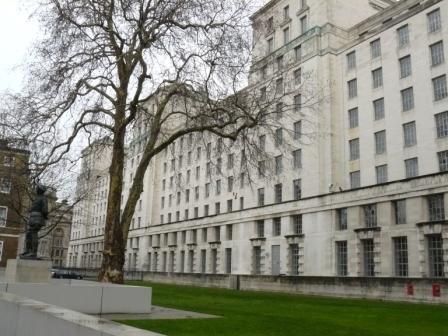
Oh, old Monty – seen here (3rd pic) in a statue close to the UK’s Ministry of Defense (2nd pic) – , would you trust him if he were to tell you how to fight a war or rather not fight it? Could soldiers serving under the Union Jack (1st pic) in Afghanistan trust him?

Would anyone from Whitehall believe his promises of tax cuts when Britain is almost bankrupt? Won’t voters fear that a hung parliament could severely affect their lives?

[For all the posts on this blog go to/Pentru toate postările de pe acest blog mergi la: Contents/Cuprins]

Sunday, 6 December 2009

A crossroads of the Orthodox World (5) [O răscruce a Lumii Ortodoxe]

As Christians worldwide are remembering St. Nicholas today, Romanians are going to the polls again to choose – as I have already anticipated – the lesser of two evils.

Both candidates swore on the Holy Bible some 72 hours ago, stating that they are not guilty of one serious (from quite a long list, actually) accusation raised against them. Supporters from both camps have serious reasons to believe they are liars.

It may not be as exactly as bad as picking between Hitler and Stalin, as our great-grandfathers had to choose 65-70 years ago, but the choice is not too far from that either.

Irrespective of who wins, we’re either on the brink of civil war of economical collapse. Or both :-(

More than it needs a President and a new (properly working, not interimary) Cabinet, this country (already a storm-tossed ship!) would need a wonder-worker like St. Nicholas…

… as he is pictured here, taming a tempest, on a wall a the Stavropegic Monastery of St. John the Baptist, in Tolleshunt Knights (Maldon, the ‘irreligious’ Essex, SE of England).

This Orthodox monastery on British soil has some great icons and pictures (here’s another episode on this issue), and I find myself constantly amazed with the significations these images can reveal to one’s heart.

It seems to me that St. Nicholas only comes to the rescue when those awaiting a miracle are – although tense, maybe even frightened (click here or on the first picture for a cleared view!) holding their hands firmly on the oars.

I can’t see anyhting else but extremely hard times ahead for all Romanians, but any storms (albeit drawn upon us by our own sins) can be sailed through by those who will hold on to their faith.

Maybe such times are allowed by the Lord to see how much faith is left in Romania...

[For all the episodes of this series, and all the posts on this blog go to/Pentru toate episoadele din această serie şi toate postările de pe acest blog mergi la: Contents/Cuprins]

Saturday, 21 November 2009

About public transport in the UK (10) [Despre transportul în comun în UK]

This may be one of the weirdest posts I’ve ever published here, as only the pictures have anything in common with the theme of the curent series… But I can’t help writing another little story on an up-to-date Romanian reality, using British realities as background.

I may be hopelessly trapped within my own vanity – foolishly imagining that this MunteanUK is somehow interesting (?!) within its bizzareness or, at least, remains very different than a million other dull blogs.

Anyway, here’s what crossed my mind as I remembered the guy in the second image. He is a crook who approached me in Victoria Coach Station, and who tricked me into giving him £ 3-4, so that he could buy a ticket.

It didn’t matter that I had just heard Big Brother’s voice warning the passengers against this peculiar sort of beggars. Like all crooks, he came up with a what appeared to be a convincing story, almost hypnotizing me.

He fooled me just like a big Senegalese made me believe he was offering gold to me (a fascinating story, but only in Romanian) three years ago, in Cape Verde. Both in this British bus station and in Mindelo, I felt I was being tricked just as this was happening, but I couldn’t prevent it.

It wouldn’t be true to say that I am experiencing the very same feeling ahead of the Romanian presidential elections. Yet I wonder whether I’m not being tricked again, as long as – unlike most of the Romanian citizens – I want to go and cast my ballot.

Many people in Romania, of all ages and walks of life – both from the ever shrinking group of Orthodox faithful who practice their belief, and from the bulk of irreligious people – won’t bother to vote. Nevertheless, I want to do it.

I’ve made up my mind ever since my ‘favourite’ announced that he would be running for presidency this year. Although I’m far from being hyperenthusiastic (I’m leaving that for Obamaniacs all over the world), I’m comfortable with my decision.

Democracy is often a Russian roulette, and there’s not much genuine choice left for the voters. Citizens can only choose between some characters who had been previously pushed on the political stage by puppeteers.

Is the same choice left for Romanians tomorrow?! I couldn’t tell. All I honestly feel (it’s a feeling, I can’t explain it!) is that voting is better than not voting. I don’t believe in the theory of sanctioning (or delegitimizing) the political leadership by voting absenteeism.

Far be it from me to judge those who choose not to vote. God will judge us all, most likely not according to our political choices, like we often judge one another. Whether we vote or not, I feel like the whole country is in a bus station on the eve of these elections.

We can hop on the right or the wrong bus, not necessarily according to our wise or unwise choice, but to God’s will. The safety of the journey ahead of us depends not so much on the skills of the driver; it is all up to the Lord, and to how closely we follow His commandments.

[For all the episodes of this series, and all the posts on this blog go to/Pentru toate episoadele din această serie şi toate postările de pe acest blog mergi la: Contents/Cuprins]

Friday, 6 November 2009

Witty bits from what I learned in the UK (12) [Vorbe de duh din ce am învăţat în UK]

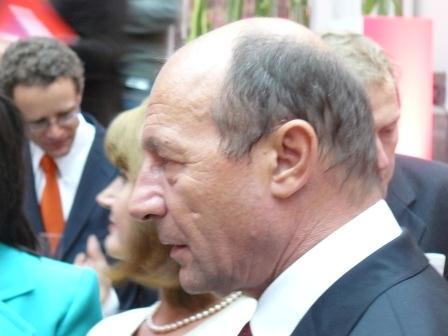
The man with the grim appearance in the picture (which I took in October 2007, in Brussels) is Romania’s incumbent president – Traian Băsescu – a character who, in my humble opinion, draws equally irrational devotion and irrational adversity.

The paradox is that he probably deserves both the support and scorn he receives, and he’s no better, nor worse than the kind of ruler Romanians deserve today.

He’s the the one against whom all other competitors in the next presidential elections (due on Nov 22nd, with a most likely run-off on Dec 6th) are running, as the vote will basically be a referendum concerning his person.

Should he be granted a second term or not? ...this is the Shakesperean question troubling the few Romanians – probably no more than a third of citizens eligible to vote – who would bother to go to the polls.

I don’t know if the following piece of information is helpful to anyone in making up their minds about voting for or against Băsescu, but I feel like sharing here another ‘witty bit’ that I learned in the UK.

What I heard is a sinthetic description of Băsescu’s ‘finest hour’ – the 2004 victory in the presidential elections, made by someone very familiar with Romanian politics.

A British political scientist described to me Băsescu’s Orange Revolution as being “the revolution of the millionaires against the billionaires.

As I said, anyone can take this both ways – as an argument in favour or against Băsescu. I’d rather not give my own verdict, hoping that I’ve still got some readers left who would be interested in posting a comment on this topic.

[For all the episodes of this series, and all the posts on this blog go to/Pentru toate episoadele din această serie şi toate postările de pe acest blog mergi la: Contents/Cuprins]