Showing posts with label Rome. Show all posts

Wednesday, 28 August 2013

[EN] Every 99 years… / [RO] La fiecare 99 de ani…

[EN] Almost every 99 (+/- a few) years, something significant has been setting the world on fire over the centuries. [RO] Aproape la fiecare 99 (+/- câţiva) ani, ceva semnificativ a aruncat lumea în flăcări de-a lungul secolelor.
.
[EN] Many suspect me of being a conspirationist and may wonder where did I get this wacky ideas from. [RO] Mulţi mă suspectează că sunt un conspiraţionist şi s-ar putea întreba de unde am aceste idei năstruşnice.
.
[EN] I just noticed this… curiosity, made some subractions and searched for historical data. [RO] Eu doar am observat această... curiozitate, am făcut nişte scăderi şi am căutat date istorice.
.
--- --- --- --- --- --- --- --- --- --- --- ---

.2013 - 99 = 1914
[EN] The beginning of the First World War (1914-1918) that would bring the end of three empires and the rise of the USSR. [RO] Începutul Primului Război Mondial (1914-1918) care va aduce sfârşitul a trei imperii şi ridicarea URSS.

1914 - 99 = 1815

[EN] The End of Napoleon Bonaparte’s adventure and the beginning of the Perfidious Albion’s supremacy known as Pax Britannica. [RO] Sfârşitul aventurii lui Napoleon Bonaparte şi începutul supremaţiei Perfidului Albion cunoscută drept Pax Britannica.

1815 - 99 = 1716
[EN] The battle of Petrovaradin, one of the first nails in Ottoman Turkey’s coffin. [RO] Bătălia de la Petrovaradin, unul dintre primele cuie în coşciugul Turciei Otomane.

1716 - 99 = 1617
[EN] The fervent counter-reformist Ferdinand II is elected King of Bohemia and The Thirty Years War begins the following year. [RO] Ferventul contra-reformist Ferdinand al II-lea este ales Rege al Boemiei şi Războiul de Treizeci de Ani începe anul următor.

1617 - 99 = 1518
[EN] The Treaty of London marks the first attempt of European Integration and building a lasting peace of the continent. [RO] Tratatul de la Londra marchează prima încercare de Integrare Europeană şi edificare a unei păci durabile pe continent.

1518 - 99 = 1419
[EN] Western Europe was caught in the Hundred Years War, and the Hussite Wars would break after Jan Hus’ execution in 1415. [RO] Europa de Vest era prinsă în Războiul de O Sută de Ani, iar Războialele husite vor izbucni după execuţia lui Jan Hus în 1415.

1419 - 99 = 1320
[EN] France is confronted with the so-called Shepherds’ Crussade, a chaotic anti-nobility and antisemitic movement. [RO] Franţa se confruntă cu aşa-zisa Cruciadă a Ciobanilor, o haotică mişcare anti-nobiliară şi antisemită.

1320 - 99 = 1221
[EN] The Mongols begin their conquest of Central Asia, killing one million people in Merv (ancient Persian city) that year. [RO] Mongolii încep cucerirea Asiei Centrale, ucigând un milion de oameni la Merv (străvechi oraş persan) în acel an.

1221 - 99 = 1122
[EN] Byzantine forces under Emperor John II Komnenos defeat the Pechenegs which would disappear from history. [RO] Forţele bizantine de sub comanda Împăratului Ioan al II-lea Comnen îi înving pe pecenegi care vor dispărea din istorie.

1122 - 99 = 1023 - 99 = 924 - 99 = 825 - 99 = 726
[EN] Byzantine Emperor Leon III Isaurus bans the worship of icons, thus the iconoclastic rage begins. [RO] Împăratul bizantin Leon al III-lea Isauricul interzice cinstirea icoanelor şi astfel începe furia iconoclastă.

726 - 99 = 627
[EN] The founder of Islam, Muhammad, creates a confederation of tribes in today’s Saudi Arabia and his beliefs spread in the area. [RO] Fondatorul islamului, Mahomed, creează o confedereaţie de triburi în Arabia Saudită de azi şi credinţele sale se răspândesc în zonă.

528 - 99 = 429 - 99 = 330
[EN] Emperor Constantin the Great moves the capital of the Roman Empire to Constantinople. [RO] Împăratul Constantin cel Mare mută capitala Imperiului Roman la Constantinopol.

330 - 99 = 132 - 99 = 33
[EN] Some scholars consider the year 33 AD as the year the Crucifixion, while all agree to place it sometime in the years 30-36. [RO] Unii cercetători consideră anul 33 AD drept anul Crucificării, în timp ce toţi sunt de acord să o plaseze cândva între anii 30-36.

[EN] As long as, since then, we know that Christ is Risen!, there are reasons for hope, no matter what world cataclysm awaits us. [RO] Câtă vreme, de atunci încoace, ştim că Hristos a înviat!, sunt motive de speranţă, indiferent ce cataclism mondial ne aşteaptă.

[EN] As for something bad happening that year – a grave financial crisis erupted in Rome, leaving many aristocrats bankrupt. [RO] Cât despre ceva rău petrecut în acel an – o gravă criză financiară a izbucnit la Roma, lăsând faliţi mulţi aristocraţi.

--- --- --- --- --- --- --- --- --- --- --- ---

1914 + 99 (+1) = 2013/2014
[EN] What next? [RO] Ce urmează?

[For all the posts on this blog go to/Pentru toate postările de pe acest blog mergi la: Contents/Cuprins]

Monday, 15 October 2012

The most beautiful park I’ve ever seen... [Cel mai frumos parc pe care l-am văzut vreodată...]

The most beautiful (and anti-consumerist) park I’ve ever seen…

…is the Caffarella Park, in Rome (a bit of it in the 2nd pic), Italy.


Briefly mentioned before on MunteanUK, I think it is…

…one of the most wonderful places in the world.


Of course, I haven’t seen too many countries of the world…


…thus not quite so many parks :-(


However, I dare holding on to my opinion.


There are several pedestrian alleys and bicycle paths...


...albeit unpaved and unmarked (11).


Some sheep (7), and a farmhouse (6, 8) from the 1500s.


Some villas (12) and ruins (4) from the time of the Romans.


And at least one metal bridge and a metal water pump.


Everything else is almost completely natural, unspoilt, peaceful.


As it has been just made by God.

[For all the posts on this blog go to/Pentru toate postările de pe acest blog mergi la: Contents/Cuprins]

Friday, 7 September 2012

Lay monuments pointing at the sky [Monumente laice arătând către cer]

Isn’t is fascinating to witness that most (if not all) secular societies’ monuments are still pointing at the sky?

Even after scrapping the idea of divine authority over the earth and distancing themselves from the very concept of God (deemed as obsolete, backward, useless today etc) people are looking up to the visible skies and beyond.

Fewer and fewer are those drawn to Christ’s love, while more and more are those eager to welcome aliens descending from UFOs.

Nevertheless, all people (religious or self-worshipping irreligious), from all places and all ages, have always been secretly yearning for some kind of salvation from a world whose progress has only put and tightened a noose around our necks.


Cathedrals and churches are still towering cities in many countries of the Old Continent (most of which is part of the secular EU).


Some are abandoned ruins (see pics from Scotland here or here), others are turned into cafés or stores, however, they are still here with us, getting in the way of those who banished from God their minds and reject His natural laws.


People can’t live without a certain innate aspiration to verticality, can they? Hardly any monumental work of art could express greatness horizontally. 


Followed either legitimately (“I am the Way, the Truth, the Life”) or illegitimately (through an anthropocentric Tower of Babel), this upward aspiration is inherent in human nature. 

[For all the posts on this blog go to/Pentru toate postările de pe acest blog mergi la: Contents/Cuprins]

Thursday, 12 July 2012

Înfruntând canicula… [Facing the heat…]

Unii ar prefera o bere australiană sau orice bere (într-un tren din UK, precum în poza de aici – deşi nu era caniculă :-)...

Alţii aşa-zisa bere de ghimbir’, care este tot un suc carbonat (inventat în SUA)...

Sau un suc cu bucăţele de aloe şi piersică produs în Arabia Saudită (cumpărat de aici)...

O cutiuţă nu prea atrăgătoare de îngheţată comunistă nu prea dulce (la Shanghai)...

Un suc de rodii proaspăt stors, cam înecăcios faţă de cel cu chimicale care imită aşa-numitul fruct al pasiunii (la Istanbul)...

O bucăţică, prea mică pentru cât de scumpă (la € 1), de nucă de cocos (pe străzile Romei)...

Bune toate, dar eu aş zice că un suc de guava (produs de o firmă din India, probabil în Ţările de Jos) merge cel mai bine...

[Pentru toate postările de pe acest blog mergi la/For all the posts on this blog go to: Contents/Cuprins]

Friday, 9 December 2011

‘Oamenii de rând’ în arta urbană britanică [The ‘commoners’ in British urban art]

Într-o ţară mândră trecutul glorios precum Marea Britanie, te-ai aştepta să întâlneşti prin oraşe numai statui cu personaje măreţe.

Adică oameni care au rămas în istorie, de la eroi medievali (exemplu foto deja postat de mine) până la generali din cel de-al Doilea Război Mondial (foto).

Desigur, există nenumărate astfel de statui, să le zicem clasice, cu oameni de stat (foto) şi războinici în posturi victorioase sau încrâncenaţi în luptă.

În alte cazuri, ostaşii sunt surprinşi deloc tipic statuesc’, ci, pur şi simplu, în clipele de răgaz ale războiului de poziţii din 1914-1918 sau răpuşi (foto).

Dar este ceva care mi-a părut neobişnuit, ca vizitaror venind din jumătatea estică a UE, pentru că n-aş zice că obiceiul este lipsit de echivalent în jumătatea vestică a Uniunii.

Anume numărul destul de mare (în comparaţie cu ce puţine fotografii am pentru a-mi proba observaţia) de statui cu oameni de rând’ (commoners).

Sunt convins că trebuie să fie un curent (trend) mai recent, poate nu mai vechi de 15-20 de ani, dar ale cărui efecte se cunosc deja în peisajul urban britanic.

Şi nu mă refer doar la muzee, precum Migration Museum din Liverpool, unde este firesc să apară grupuri statuare cu imigranţi istoviţi (poza 4).

Muritori de rând pregătiţi şi cu feţe parcă emoţionate de iminenta călătorie apar şi în faţa micuţei, dar elegantei gări Liverpool Street Station din Londra (poza 1).

În Autogara Buchanan din Glasgow ochii trecătorilor nu pot omite o imortalizată îmbrăţişare – şi ea destul de clasică, specifică unor vremuri mai romantice decât zilele noastre (foto).

În Birmingham, dai peste statui cu un aer mai cunoscut pe meleaguri româneşti (poate şi la Roma), oarecum... proletcultist.

Avem un muncitor (?! – nu-s sigur – poza 2), un marinar (poza 6), un soldat (poza 5), ba poate chiar o muză revoluţionară (?! – iarăşi nu-s sigur – poza 3).

În Edinburgh, până şi potăile de rând (însă devenite simboluri ale oraşului) ca Greyfriars Bobby se bucură de statui chiar şi într-un hol de hotel de patru stele (poza 7).

Cu mulţumiri cititorului meu Mihai Gociu pentru imaginile 2-6, aştept şi părerile altora despre arta urbană din UK.

[Pentru toate postările de pe acest blog mergi la/For all the posts on this blog go to: Contents/Cuprins]

Saturday, 3 December 2011

Will the Eurozone crack? [Va crăpa Eurozona?]

More than three years after the Wall Street Crash of 2008, the unthinkable demise of the euro and the break-up of the Eurozone has (apparently) become plausible.

It’s getting crystal clear even to the most fanatic euroenthusiasts that any imminent economic cataclysm cannot be blamed on convenient scapegoats anymore.

The lazy Greeks, the irresponsible governments in Eurozone weak links countries (PIIGS), along with greedy bankers everywhere may have played relatively secondary roles in influencing the destiny of the EMU.

Nevertheless, the fate of the European currency has never been – nor is it in these very days of turmoil – in the hands of less important actors like the above.

The devil lies in the details of EU treaties and especially in the chain of misdeeds committed by the political leaders of Europe, whether acting unilaterally, from Berlin, Paris or Rome, or together, from Brussels.

Hardly could the roots of the current crisis be located in Frankfurt, as the ECB has seldom had its hands united by the heads of state and government reunited in the Council of the Union.

More and more independent economists show that the mess engulfing the EU and threatening to blow up the global economy has systemic causes.

The EMU is on the brink of disaster because it lacks several fundamental premises of an efficient monetary union; it is made up of an econimic ‘giant’ (Germany) with 16 ‘feet of clay’ of various strengths from stronger (France) and weaker (Italy) muscles to negligible appendices (Estonia).

The ECB could be reasonably functioning as a central bank (if allowed to act do so), yet there is no effective equivalent of a national Treasury (Ministry of Finances) or Government in Brussels.

For decades, EU leaders have been deploring the lack of a common defence policy (greatly compensated by NATO) or of a common energy policy (whose absence contributes to the fact that Europeans are often ‘energy hostages’ of Russia).

It was fashionable to complain about these issues, however, none was as divisive and able to threaten the survival of the EU as the other skeleton that the current crisis took out of the Union’s closet – there is no common fiscal policy of the EMU.

In its absence, sooner or later, the Eurozone would be doomed to crack, like some analysts anticipated in the late 1990s, if not even longer before, around the dawn of this project.

The flaws of the EMU were known from the very beginning but swept under a carpet of great expectations about increased common prosperity.

For a while, the illusion worked. After the first months of wariness, when many Europeans in euro countries were shocked by price hikes, almost everyone grew accustomed with a stable currency, no need for exchange rates, low inflation and bearable interest rates.

The Greeks, Spaniards, Portuguese and others had access to cheap credit, while their tourist industries cashed in strong euros, instead of weak drachmas, pesetas or escudos.

In the meantime, the euro was weaker than how the Deutsche Mark would have probably been in the 2000s, enabling Germany to be biggest world exporter in 2007, ahead of China.

The success story seemed complete, and many warnings (like the ones about Italy being unfit for EMU membership (+ here, here, here) – see the pics*** illustrating this article!) were bluntly dismissed as nonsensical soothsaying.

Actually, there’s growing evidence that it was well-known to the architects of the euro that the Eurosystem was ill conceived from the start.

This didn’t prevent them from taking a huge gamble on the hope that a severe crisis (like the one the world has endured since 2008) would eventually help establish a “a more perfect union,” like the Constitution of the USA aimed in 1787.

Is this imperfect monetary union perfectible? Are the 17 euro countries willing to take upon themselves the full political cost of making the EMU truly functional?

And could giving up more of one country’s sovereignty guarantee anything for the EU’s citizens (“we the people,” if we were to quote the US Constitution again), apart from helping save the banking system from collapse?

Will a ‘full fiscal union’ work better than the current ailing EMU? The Eurosystem would probably run smoothly, yet the imbalances between the 17 economies would remain as grave as they are today, if not even worsen.

Smothering public deficits from the cradle would not grant choices of more responsible political leaders to European voters; it would merely ignite more vicious political battles and maybe even class conflict within nations.

And, riskier than anything else, wouldn’t this ‘EU Treasury’ remain as unaccountable to European citizens as other EU institutions and leaders that created the current ‘euro-mess’ have always been?

[For all the posts on this blog go to/Pentru toate postările de pe acest blog mergi la: Contents/Cuprins]

*** NOTE: Simon Tilford, from the Center for European Reform (London based think-tank), warned that “if Italy fails to improve its competitiveness, it will eventually have to leave the Eurozone” (2006).

Monday, 24 October 2011

Din raidurile mele prin inima Scoţiei (23) [From my forays into Scotland's heartland]

De cum le-am descoperit, am lăudat suvenirurile din Londra, ca fiind un pic cu mai multe plusuri decât minusurile pe care le găseşti la astfel de obiecte în alte părţi ale lumii.

Iată că aşa s-a nimerit ca, după mai multă vreme, să apuc să le laud şi pe cele găsite în Edinburgh, un ‘oraş-acasă-ideală’ vizitat de trei ori până acum.

La fel ca în Londra sau în orice altă capitală a lumii (inclusiv în Washington DC, Paris, Roma sau Berlin!), mai dai şi aici peste suveniruri made in China’.

Ba chiar am aflat şi m-am grăbit să cumpăr (pentru inscripţiile cu Scotland şi drapelul cu Crucea Sf. Andrei) şi peste nişte tricouri  made in Haiti’ (poza 5).

Mare ţeapă am luat, căci deşi erau de bumbac 100% (şi după ce scria pe etichetă, şi la atingere), aveau o duhoare de parcă ar fi fost produse într-o tăbăcărie :-(

Aceasta a fost singura experienţă negativă. Restul suvenirurilor văzute, pipăite şi cumpărate au fost toate de nota zece.

Mai ales cele cu adevărat made in Scotland’, din lână locală (plovăre, fulare, căciuli, fuste, şepci etc), sau biscuiţii de ovăz (4) – şi gustoşi, şi buni pentru digestie.

De la deja clasicele brelocuri şi magneţi de frigider (3) sau căni (2) până la rechizite cu însemne scoţiene (1), toate mi-au plăcut.

Iar acestea erau, în mare, lucrurile de găsit pretudindeni în oraş, pe când cele mai bune suveniruri (dar şi mai usturătoare ca preţ) se găsesc la Edinburgh Castle.

Oferta este foarte bogată, toate produsele sunt, efectiv, realizate în Scoţia, dar şi de o calitate care îşi merită banii şi nici nu te face de râs dacă îţi decorezi casa cu ele.

Astfel de obiecte chiar frumoase, nu doar bune de a te da mare că le ai din Scoţia sunt tapiţeriile tradiţionale (6), mai interesante decât clasicele Răpiri din Serai :-) zic eu...

Dacă nu-ţi permiţi una de perete, te poţi mulţumi cu o faţă de masă sau semn de carte (9) sau cu un joc de şah (10), deşi destul de costisitor (£ 50).

Faţă de cănile de duzină din oraş, la castel găseşti unele şi mai frumoase, şi de 4-5 ori mai scumpe (13).

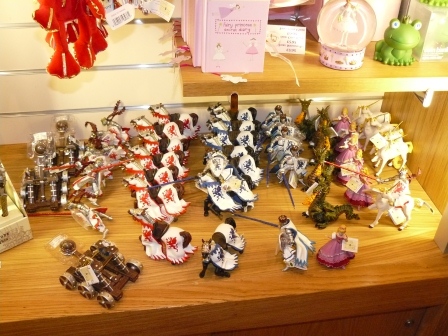
Mai poţi cumpăra cărţi de joc cu imagini din Scoţia (14) , bijuterii (12), săpunuri (13), săbii şi diademe pentru copii (8) şi jucării pentru colecţionari de toate vârstele (7).

[Pentru toate episoadele din această serie şi toate postările de pe acest blog mergi la/For all the episodes of this series, and all the posts on this blog go to: Contents/Cuprins]