Showing posts with label Immigration to the UK. Show all posts

Friday, 8 February 2013

Romanians, victims of racism in Brighton [Români, victime ale rasismului în Brighton]

Some four and a half years ago, in August 2008, a Romanian “was battered with fire estinguisher” in King’s Road, a well-known seafront street of Brighton.

What an awful thing to happen in the fun-loving Brighton, often praised as a European capital of tolerance, open-mindedness, political corectness and restless partying!


The man – aged 28, father of two, and owner of a little demolition and earth-moving firm – would die after eight days in hospital.

Tragic as it was, the incident didn’t bear racial connotations. The Romanian victim, described as “a really kind-hearted guy” happened to be in the wrong place at the wrong time.


This excuse doesn’t seem to be valid in relation to the last violent attack to which two Romanians fell prey in Brighton a couple of weeks ago, in late January.

The two Romanians were specifically asked where they were from before being punched. Again, the beating took place in central Brighton – on a bus stop near the Royal Pavilion (pics 1 & 7).
It is the Sussex Police, not I (nor the Romanian media), that treats the crime as a “racially aggravating assault”, appealing to witnesses to come forward and say what they known.

These are places where I personally felt safe. However, this is no longer the case for many third (or even fourth!) class European citizens from Romania and Bulgaria.
Less and less welcome in Britain, Romanians and Bulgarians have been the target of a smear campaign lately.

They steal the jobs of Brits, they overburden the social security system and they generally cause a mess that Britan would be better off without.
By the beginning of next year, the restrictions on the UK job market for Romanians and Bulgarians should be lifted, and tabloids are aghast with this perspective.

But they felt the same in late 2006, before Romania and Bulgaria joined the EU. And the hordes of unwanted immigrants didn’t plunder Britain, did they?


It is not this group of underprivileged immigrants – the target of prejudice just like the Irish workers were in Victorian Britain – that would make the UK’s situation much worse.

Sadly, even for flagbearers of democracy like Great Britain it is easier to put the blame on various scapegoats, rather than uproot the true ills of society which are of a moral nature.

[For all the posts on this blog go to/Pentru toate postările de pe acest blog mergi la: Contents/Cuprins]

Friday, 16 March 2012

[EN] Hail to competing sites / [RO] Salutări siteurilor concurente (21)

** [1] ** [EN] Thanks to Google, many are those who land on MunteanUK looking for information about life in... England (rarely Scotland or the UK in general). [RO] Datorită lui Google, mulţi sunt aceia care aterizează pe  MunteanUK căutând informaţii despre viaţa în... Anglia (rar Scoţia sau UK în general).

** [2] ** [EN] What they find here is rather scarce and irrelevant, while many of my views are surely unpopular. [RO] Ceea ce găsesc aici este mai degrabă sporadic şi irelevant, în timp ce multe dintre părerile mele sunt sigur nepopulare.

** [3] ** [EN] In order to atone for creating false expectations, I selected these websites – click on the five figures on the left! [RO] Pentru a-mi ispăşi crearea de aşteptări false, am selectat aceste siteuri – click pe cele cinci cifre din stânga!

** [4] ** [EN] They answer to most questions on the ‘Romanians in the UK’ topic, with lots of honestly reported experiences. [RO] Ele răspund la cele mai multe întrebări pe subiectul români în UK’, cu multe experienţe onest relatate.

** [5] ** [EN] The only warning I give is that the outlook on Great Britain is – take it both for the better or the worse of the meaning – very Romanian. [RO] Singurul avertisment pe care îl dau este că perspectiva asupra Marii Britanii este – luaţi-o deoportivă în sensul mai bun sau mai rău al înţelesului – foarte românească.

[For all the episodes of this series, and all the posts on this blog go to/Pentru toate episoadele din această serie şi toate postările de pe acest blog mergi la: Contents/Cuprins]

Wednesday, 15 February 2012

Witty bits from what I learned in the UK (21) [Vorbe de duh din ce am învăţat în UK]

Less than a year after the biggest wave of EU enlargement, the better off (Western) half of the European Union was more or less terrified by the prospect of an invasion of low skilled workers from the new Member States.

On a peaceful, stable and prosperous continent – too bad that these certitudes’ would be put in doubt sooner than most people could have imagined in May 2004 or January 2007 – this kind of scaremongering was a lucrative strategy for many newspapers.

East Europeans were allegedly rushing to the former paradise that had been protected by the Iron Curtain, in order to feast on its delights, but bring nothing in exchange. So it was told by some, so it was believed by many.

For anyone coming from the poorer (Eastern) half of the EU, those assumptions were preposterous from the beginning.

With some exceptions (tens of thosands at most) most of the intra-EU migrants (about two million only from Romania) would not be savage migratory hordes, but law-abiging taxpayers in their adoptive countries.

By no means were these second class Europeans’ inherently  prone to pulverise the social structures of the Welfare States which had already been weakened by numerous homegrown causes.

The archetipal threat was – as it was portrayed initially and mainly in France, but not exclusively there – the Polish plumber.

This character was meant to represent a cheap worker, with unverifiable skills, who was free to access the labour market, thus to steal’ the jobs of the locals.

A large number of foreign workers would drive wages down, make trade unionism falter, and cause massive unemployment.

A EU commissioner from the Netherlands dared to claim that, contrary to popular belief in the threat’ posed by such workers from the new Member States, he would entrust a Polish handyman with taking care of his second home in France.

When I was in the UK, I asked someone (an economic researcher) whether a similar fear of foreign plumbers existed in Britain, beyond the hysteria of the tabloids.

His answer is another witty bit’ which explains the success of Polish (+ Romanian, Estonian, Hungarian etc) plumbers (+ other workers) have been having in many EU countries over the past years:

“The British plumber is not as good as the Polish plumber, and the latter may even smile to you. Skills of the lower part of  the population are not as good as in Eastern Europe.”

[For all the episodes of this series, and all the posts on this blog go to/Pentru toate episoadele din această serie şi toate postările de pe acest blog mergi la: Contents/Cuprins]

Tuesday, 3 January 2012

[EN] Hail to competing sites / [RO] Salutări siteurilor concurente (20)

[EN] Where do young bright minds go, when they leave Romania? More and more often these days – to a British university[RO] Unde se duc minţile strălucite, când părăsesc România? Tot mai des în aceste zile – către o universitate britanică...

[EN] Will they stay young and bright? That’s a thing no education system could guarantee to anyone. [RO] Vor rămâne tinere şi strălucitoare? Acesta nu-i un lucru pe care vreun sistem de învăţământ să-l poată garanta cuiva.

[EN] In spite of its attractiveness described on this blog, as well as on other sites (here, here, here) [RO] În ciuda atractivităţii sale descrise pe acest blog, precum şi pe alte siteuri (aici, aici, aici).

[EN] Studying and living in the UK may not be (the inexistent) ‘heaven on earth’  (possible reasons: here, here, here) [RO] A studia şi a trăi în UK n-o fi (inexistentul) rai pe pământ’ (posibile motive: aici, aici, aici).

[EN] Still, Great Britain remains a land of opportunity for students from all over the world, especially from the EU. [RO] Totuşi, Marea Britanie rămâne un tărâm al oportunităţilor pentru studenţi din întreaga lume, în special din UE.

[EN] Getting there and finding a ‘good life’ may not be too hard, however, finding happiness will be as hard in the UK as in Romania. [RO] A ajunge acolo şi a găsi o ‘viaţă bună’ n-o fi prea greu, dar a găsi fericirea va fi la fel de greu în UK precum în România.

[EN] Universities and (apparently!) meritocratic societies may provide tools for earning one’s (presumably better) living. [RO] Universităţile şi societăţile (aparent!) meritocratice pot oferi instrumente pentru a-ţi câştiga o (presupus mai bună) existenţă.

[EN] But they can never grant a meaning to anyone’s living… Do the bright minds know this when they leave the meaningless Romania? [RO] Dar nu pot dărui niciodată un sens pentru viaţa cuiva… Ştiu aceasta minţile strălucite când părăsesc lipsita de sens Românie?

[For all the episodes of this series, and all the posts on this blog go to/Pentru toate episoadele din această serie şi toate postările de pe acest blog mergi la: Contents/Cuprins]

Wednesday, 10 August 2011

Towards a grievous failure of British democracy [Către un eşec dureros al democraţiei britanice]


Six years ago, in that blazing autumn that saw France engulfed by violence (to a degree not seen since 1968 or even 1871), what is happenig today in many British cities (London + its suburbs, Birmingham, Bristol, Liverpool, Manchester, Nottingham) seemed utterly inconceivable.

The French had granted citizenship to immigrants, irrespective or nationality and religious background, therefore they should have considered the ‘risk’ implied by this more or less forceful integration, many British thinkers were probably imagining.

Whilst on the contrary, multicultural Britain had offered homes that retained all ethnic and religious peculiarities (from the fartherst corners of Asia and Africa to the Carribean and Eastern Europe) to millions of people.

The British model was deemed superior, many believed, because newcomers were not forced to adhere to abstract values such as those of the French Republic

Instead of that, they were likely to become law abiding citizens of a country that let them live their way, with little-to-none interference of the state in their lives.

The presumed solidity of this approach was hailed during the time when T. Bliar and his gang were in power (1997 – 2010), and every now and then Britons (and friends of Britain, like me :-) were exposed to ‘success stories’ about multiculturalism.

They sounded good: communities were interwoven by racial harmony, peace, understanding, respect for diversity, a climate of political correctness and allegiance to democratic values. All of these and economic prosperity overlapping.

Then the economic crisis struck Britain, followed by severe public spending cuts, and in early 2011, PM David Cameron openly acknowledged the failure of multiculturalism.

In theory, multiculturalism looked great – as appealing to the eye as these pictures of little streets from the City of London, a melting pot that, since the late 1600s to our days has been home to French Huguenots, Jews, Irish, Africans, African-Americans, Indians, Chinese, Pakistanis etc.

In practice, the often questioned multicultural achievements of British democracy lie shattered among the broken windows, broken skulls, and burning shops in British (only English, no Scottish, Welsh or Irish so far!!!) cities that no long before were ‘dream destinations’ for people from all over the world.

The mobs are not ‘united in diversity’ (as the EU motto claims) on the streets of British cities that I have so often praised as beautiful; there’s but a sort of ‘unity’ in discontent, rage, and meaningless devastation.

Not that I would find a political claim excusable, however, any political stance supported by the people on the streets could be at least understandable. Yet there is no such thing.

Just like the blitz riots in Canada’s most liveable city (2011), like those in France (2005), in the USA (1992), what is happening in the UK these days can’t be understood without taking into consideration the moral abyss into which Britain has been sucked for the past decades.

Unlike the localized Brixton Riots (of 1981, 1985, and 1995), these widespread events may have farther reaching consequences, in spite of (or precisely because of…) the hoodlums’ having no official agenda.

From one perspective, this makes the riots very convenient for everyone. Firstly, they look like a difficult (on the short term) but politically rewarding (on the long term – if dealed with wisely) task for the UK Government, which is very unlikely to draw any opposition to a massive crackdown.

Apart from Trotskyists and other weirdos, plus Tony Bliar’s former friend in Lybia, it’s hard to believe that anyone agrees with the violence in Britain.

Nevertheless, it is difficult to say whether UK’s law enforcement agencies, crippled by budgetary cuts, could come up with a swift response to the violence.

It appears that the summer of discontent has still reached Britain, and I wonder whether Cameron and Clegg have the strength to deal with a prolonged crisis (such as Margaret Thatcher’s miners’ strikes) in case the British riots will last as long as those in France.

Secondly, hordes of unorganised (?!) looters with no demand (albeit as skilled at using new technologies as those that ignited the so-called Arab Revolutions), and acting like mere Pavlov’s dogs, are also very convenient to Britain’s enemies. 

As the cradle of ancient democracy (Greece) is faltering, it’s sad – but not surprising, for a great nation where atheism is in full bloom – to see that the egg from where democracy as we know it today hatched (Great Britain) is crumbling.

[For all the posts on this blog go to/Pentru toate postările de pe acest blog mergi la: Contents/Cuprins]

Wednesday, 6 July 2011

Witty bits from what I learned in the UK (19) [Vorbe de duh din ce am învăţat în UK]

I may have been surprised by the number of French people living in London, although not by their presence; I knew they were ‘supposed to be there’ at least since the time of the Huguenots, if not since… William the Conqueror, that is the year 1066 :-)

That was what I equally believed about Arabs, Jamaicans, Indians, Bangladeshis, Pakistanis, (as former subjects of the British Crown), ChineseItalians (who are usually everywhere in the world)… and, of course, Greek Cypriots.

What I had completely ignored was the possibility to meet as many Turks as I did, who actually form an entire… Turkish London – a community made up of some 70,000 people (oficially) or up to 400,000 (unoficially).

Many still contest the Turks’ commitment to democratic values in the Western world acception, however, one could hardly have anything to say against their entrepreneurial spirit which is perfectly compatible with the ‘free economy’ professed by the UK.

Just like Ernst Hemingway said that in every port in the world, at least two Estonians can be found, there probably is a small Turkish business in any British city, although the bulk of the Turkish Community lives in London.

Another surprise was to realize how many foreigners are working for think-tanks and other NGOs dealing with European Affairs. Out of those we met as Chevening Fellows, one was French, one German, one Italian, and one we didn’t get to meet was… Swedish.

Does this mean that ‘purebred Britons’ are uninterested in the EU? It’s hard to tell… But I couldn’t hide the fact that I sometimes I got this impression, in spite of also meeting some staunch British supporters of the EU, both in London and Edinburgh. One was a former Tory MEP.

I don’t know how effective Turkish Lobbyists are in Britain (+ at the EU level), compared to the well-established Turkish Lobby in the USA.

It is nonetheless very interesting that all Her Majesty’s (successive) Governments supported and keep supporting Turkey’s Accession to the EU, a stance that puts Britain at odds with Germany, France, Austria & other European countries.

This state of facts makes me wonder and ask my readers – if any of them could be familiar with such issues – the following:

Of all the ethnic groups living in London, which is the most influential? Has any of these communities succeeded in influencing British politics?

Apart from the lovely English language, around 300 other tongues are spoken in this Modern Babylon. Is any of these heard louder than others at Downing Street 10?

Do immigrant communities count in London like, say, in New York? Because as much as New York seems so different from the rest of the USA, so does London ‘feel’ (not necessarily look) differently from the rest of the UK.

[For all the episodes of this series, and all the posts on this blog go to/Pentru toate episoadele din această serie şi toate postările de pe acest blog mergi la: Contents/Cuprins]

Wednesday, 25 May 2011

Din raidurile mele prin inima Scoţiei (20) [From my forays into Scotland's heartland]


Cine se scoală de dimineaţă, nu ştiu dacă ajunge neapărat departe, cum zice proverbul, dar poate vedea (şi fotografia!) multe lucruri care le scapă multora.

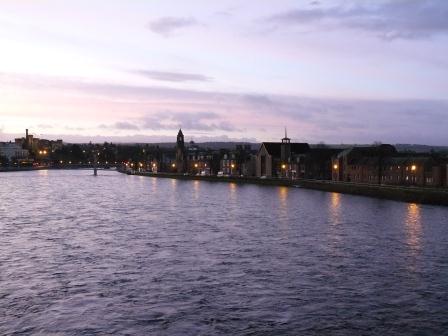
O astfel de trezire cu noaptea în cap s-a soldat cu aceste imagini din oraşului scoţian Inverness, făcute principal de pe Ness Walk.

Dacă la Bucureşti avem Dâmboviţa, iar la Londra – Tamisa, prin Inverness trece incomparabil mai curatul râul Ness, care continuă Loch Ness.

Apa curată este doar unul dintre ingredientele care plasează localitatea pe locul 5 din 189 de oraşe britanice în în privinţa calităţii vieţii.

Aerul, străzile şi parcurile sunt la fel de curate, localnicii – paşnici şi prietenoşi (măcar în general), iar economia – prosperă înainte, însă cred că şi după criză.

Cel mai nordic oraş britanic cu statut de city’ (şi cel mai nou – 2001), Inverness are vreo 56,000 spre 60,000 de locuitori.

Cam un sfert din toţi oamenii din Scottish Highlands locuiesc în Inverness, atraşi de companii din toate domeniile, de la biotehnologie la distilerii.

Sau de către University of the Highlands and Islands. Sau, ca turişti, de poveştile despre Loch Ness Monster şi de întreg aerul tipic scoţian al oraşului.

De-a lungul Ness Walk (arteră pe malurile râului Ness) eu am numărat vreo 7-8 biserici, clădiri impresionante, păcat că toate ridicate după ruperea creştinătăţii britanice de Ortodoxie.

Chiar şi înnegrite de vreme, sunt multe edificii demne de fotografiat (precum castelul ce serveşte drept  Sheriff Court – pozele 7 + 8), prăvălii interesante, pub-uri şi case drăguţe.

Dacă nu socotim Islanda, Groenlanda şi nordul Scandinaviei, cam pe aici ar fi cel mai nordic petic unde ajunge civilizaţia europeană.

Uitându-te pe hartă, parcă nu prea te-ai duce aşa departe. Dar nu este de mirare că, după o primă vizită, destui imigranţi aleg să rămână în Inverness.

[Pentru toate episoadele din această serie şi toate postările de pe acest blog mergi la/For all the episodes of this series, and all the posts on this blog go to: Contents/Cuprins]