Showing posts with label The Daily Telegraph. Show all posts

Wednesday, 23 November 2011

About public transport in the UK (21) [Despre transportul în comun în UK]

Keeping in mind that “grumbling about trains being late is almost a national hobby” in Britain, I noticed this kind of ‘worries’ reflected more and more often in the online editions of British newspapers…

…and not that they would have serious topics to discuss or gossip about :-) Thus, I find myself wondering (and simultaneously asking my readers): how serious is this issue?

Last June, a BBC report noted that “the proportion of passengers satisfied with train punctuality had gone down,” compared to the spring of 2010.

Three months later, in September, The Daily Telegraph issued a stark warning, claiming that “UK train puctuality worsens”.

And let us not forget that all these ‘worries’ have been expressed long before another Big Freeze which – to the great dismay of Global Warming hysterics – could befall Britain (again, and for the fourth consecutive year) any day now!

[For all the episodes of this series, and all the posts on this blog go to/Pentru toate episoadele din această serie şi toate postările de pe acest blog mergi la: Contents/Cuprins]

Wednesday, 13 April 2011

Material wealth and British unhappiness [Bunăstare materială şi nefericire britanică]

If I said this ‘by myself’, I could be easily accused of being ‘an anti-British bigot’, but here’s a British scholar saying it for The DailyTelegraph:

“Young people now are being brought up grasping for what they don’t have rather than appreciating everything they already do.

For everything we have gained in material wealth and sophistication in recent years, we have lost in happiness and the overall richness of the fabric of society.

If we don’t act now, in the future we are likely to see increased levels of adolescent suicide and mental illness, and a culture in which taking anti-depressant drugs is the norm.”

This is today’s money-centered Britain, where a few sane minds (see this Action forHappiness) are trying to warn that things can’t go on like this.

Raising children in a society where ‘meaning of life = financial success’ is a recipe for disaster, and the Brits are already reaping the poisonous fruits of this nihilistic ideology.

Where could have secularism, atheism, hedonism, consumerism, promiscuity lead if not to a an atomised society where only 30% (down from 60%, some 50 years ago) of people trust their fellow human beings?

I like the slogan of Action for Happiness (“Let’s put the things that matter first”), however, I feel that it is but a pipe-dream.

How many of the young people (from Britain or any other country) born in the past 2-3 decades could escape the spell of this materialistic outlook on life?

It’s nice to wish  putting the things that matter ‘first’ – but what actually matters, apart from every ‘I, me, mine, myself’ in this selfish world?

Could this self-centerd modern world where Christianity is uprooted find the way back to our Lord’s definition of happiness – the beatitudes?

Who of us is – apart so very few :-( – ready to be poor in spirit, mournful, thirsty after righteousness, meek, giving up all the nothings that apparently enrich our modern lives, so that we could find true happiness?

[For all the posts on this blog go to/Pentru toate postările de pe acest blog mergi la: Contents/Cuprins]

Sunday, 16 January 2011

UK’s motor vanity fair (20) [Bâlciul deşertăciunilor cu motor din UK]

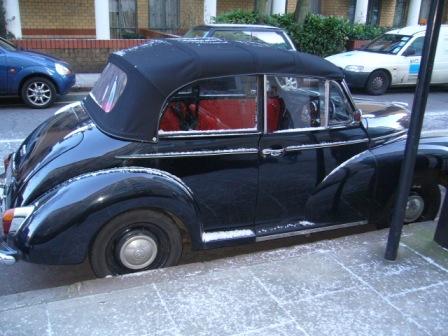
Enthusiats consider it a ‘British miracle’ and it must have been so, in 1948, when this economy car took to the British roads. Eventually, as “video killed the radio star,” so was this car of a slower-paced age killed by cars more suitable to the current maddeing faster times.

The ‘miracle’ only lasted up to 1958, when production stopped, although commercial variants kept being produced until 1971. A Total of 1,6 Morris Minor vehicles were build, but I don’t think that more than a few thousands are still in circulation.

Thanks to my reader C.L., I can add these lovely pictures of a Morris Minor to those that I took myself, and which illustrate the first episode of this series. They are glimpses of mid-20 century Britain, and offer a good example of British craftsmanship.

“In the popular imagination the Morris Minor is the car of schoolmasters, district nurses, midwives, openly Anglican vicars, helpful rural grocers and men wearing hats who are, generally, not in a hurry.”

“If the staid institution of English afternoon tea were motorised, it would look like this. The Minor is a symbol of a gracious England unspoiled by sodium lights, bypasses, tower blocks, KFC and greedy consumerism.”

“This England was a fable maybe, but fables are often more interesting than facts.” – this is how The Daily Telegraph praises the car pictured here, often seen as ‘quintesentially English’ or ‘typifying Englishness’.

[For all the episodes of this series, and all the posts on this blog go to/Pentru toate episoadele din această serie şi toate postările de pe acest blog mergi la: Contents/Cuprins]

Thursday, 6 January 2011

Christ’s Holy Face in a disfigured world [Chipul Sfânt al lui Hristos într-o lume desfigurată]

Some 1981 years ago (2011 A.D., minus the 30 years of Christ’s unseen life as child then carpenter in Nazareth), the Holy Face of God’s only begotten Son was revealed to the entire world, by His Forerunner, St. John the Baptist.

That Self-revealing of God has effects upon the world that surpass those of all scientific discoveries, revolutions, inventions, philosophies of all ages combined, which have always been foolishly idolatrized by mankind.

However, the celebration of Theophany remains a mere annual curiosity in so many once Christian nations, including orthodox Romania and secular Britain. Few people, including so-called Christians, understand the meaning of the Feast.

Outside the Christian world (made up of only One (Orthodox) Church + a myriad of heterodox beliefs) people keep hating and mocking Christ, like Herod did when He was born or like the Romans and Jews did when crucifying Him.

If they were just unbelievers (agnostics), maybe their sin was of a lesser kind (forgivable), but proclaiming themselves atheists (at war with their Maker), they are completely unscientific, as no one has ever scientifically proven the inexistence of God.

Moreover, they declare themselves to be at war with Him. They want Him out of everything His, unaware that the more they fight an inexistant God, the more they prove the opposite. That’s because all demons inspiring atheist ideologies know that HE IS.

But that’s outside the shrinking Christian world. Inside it, there are other devilish traps meant to dilute the faith, at work since the days of the Apostles, then shredding Christianity after 1054 and up to these very days.

In a world soaking with hedonism, Christ appears as ‘relative un-ascetic Christians’ would like Him to be, as they caricaturize Him, in the weirdest of circumstances. The world is disfigured, living under the spell of ‘I-do-what-I-want’, therefore it disfigures Christ.

People so unlike the angel-man John the Baptist suddenly claim to have ‘seen Him’, and such apparitions are deemed newsworthy by The Daily Mail and The Daily Telegraph. Sometimes, such news quickly travel around the world.

A Brit girl saw the Face of Jesus in her chewing gum, a banker claims to have been saved by a divine intervention, with Jesus appearing in his frying pan, a so-called church advertises itself with the Lord’s Face drawn on a beer glass.

One man from Southampton is sure that an image taken by Google Earth over a field in Hungary shows Jesus, a woman and her unlawfully wedded (they were in a concubinage) partner said they saw Him in a baby scan, next to their son sucking his finger.

A (probably quite wacky) American community saw Him crucified on a telephone pole, a couple could swear it’s Him on the door toilet of an IKEA outlet in Glasgow, while a family in Hertsfordshire recognized Him on a flaming log in the fire place.

And the list of (surreal, psychotic?!) ‘apparitions’ could go on an on. Thus, relative Christians of all denominations feel that they are refreshing their faith, while atheists have another round of laughter. Both sides are satisfied :-(

According to the teachings of His One Church, ascetics trying to live like their role model John the Baptist rarely see Him in their lifetime, then how come ordinary people, especially in a secular society like the British one, suddenly ‘see’ Him?

Are these ‘apparitions’ somehow changing the lives of these people, like in the very few cases when some future saints saw our Saviour or the Theotokos, and completely changed their lives from that moment onwards?

Maybe no more than one man or one woman in half a million is drawn by a monastic life. God only knows how many of those called are eventually chosen – not by blind fate, but by their own toil as well – to become true ascetics.

Few are those whose hearts get purified, so that there are worthy of seeing His Holy Face? It’s very likely that as few people as one human being in a billion (out of all billions that have lived!) have ever seen Him during their lives on Earth.

Yet in the contemporary world, so disfigured by sin, so away from Him and so astray from His commandments, seeing Him appears to have become a cheap curiosity. ‘Apparitions’ are so at hand these days, like going to supermarkets or switching on the TV.

Actually, seeing Him is something for which John the Baptist would have lived a hundred years in the desert or would have had his head cut a hundred times. And still there’s no price any human being could pay for this priceless gift.

So full of our petty ourselves, most of us remain unable to understand John the Baptist’s words “My joy is now full. He must increase and I must decrease.” Blessed be those extremely few humble ones who are still able, and for whom the Lord keeps the world alive!

[For all the posts on this blog go to/Pentru toate postările de pe acest blog mergi la: Contents/Cuprins]

Monday, 8 November 2010

[EN] Hail to competing sites / [RO] Salutări siteurilor concurente (11)

[EN] It’s not diplomatic, from a public relations point of view, to express my preferences openly but here I am saying it… [RO] Nu este diplomatic, din punct de vedere al relaţiilor publice, să-mi exprim preferinţele deschis, dar iată-mă spunând-o aici...

[EN] (assuming that I’ve still got readers interested in knowing this) What British newspapers does MunteanUK prefer? [RO] (presupunând că încă am cititori interesaţi să ştie aceasta) Ce ziare britanice preferă MunteanUK?

[EN] Wasn’t it obvious, given the huge number of links? I’m a ‘fan’ of the (often quoted on this blog) The Daily Mail and The Daily Telegraph. [RO] Nu era evident, dat fiind numărul uriaş de linkuri? Sunt un ‘fan’ al (des citatelor pe acest blog) The Daily Mail şi The Daily Telegraph.

[EN] Not that other Brit newspapers wouldn’t have interesting stories, but their leftist & nihilist ideology is nauseating to me. [RO] Nu că alte ziare britanice n-ar avea articole interesante, dar ideologia stângistă şi nihilstă a lor îmi face greaţă.

[For all the episodes of this series, and all the posts on this blog go to/Pentru toate episoadele din această serie şi toate postările de pe acest blog mergi la: Contents/Cuprins]