Showing posts with label Afghanistan. Show all posts

Wednesday, 18 July 2012

What makes Russia ‘great’ and what ‘belittles’ Great Britain [Ce face Rusia ‘mare’ şi ce ‘micşorează’ Marea Britanie]

Gone are the days when Napoleon Bonaparte was fearing Russia for being “the continental sword of England,” and so are the days when Winston Churchill’s Britain had to make use of the USSR as a continental sword against Nazi Germany.

Today, a general mistrust – whether polite or sarcastic at times – reigns over the relations between London and Moscow. The reasons for that are not entirely obvious.

London is no longer backing a moribund Ottoman Turkey against Tsarist Russia, nor is it offering a safehaven to thousands of White Russians, fleeing from the onslaught of Bolshevik Communism.

Neither are Britain’s and Russia’s conflicting interests in Asia so vivid as they were in 19th century, as there are is no British, nor Russian empire left.

The British armed forces are in their 10th year of what could be called a ‘Fourth Afghan War’, while London’s and Moscow’s views on Iran differ, but there’s no Great Game being played anymore. No longer British, India is rather close to Russia.

Therefore, why are Britain  and Russia are on so irreconcible terms these days?

--- --- --- --- --- --- --- --- --- --- --- ---

Of course that, beyond my above hypersimplistic geopolitical analysis, there are enough substantial differences to be found. But there are similarities even within those differences:

[1] Britain’s slow descend into a multicultural dictatorship seems incompatible with the nationalistic dictatorship of Vladimir Putin.

They are both doubtful democracies. The significant difference is that one has always been a democratic pariah, while the other has still got the BBC, which is worth several thousand bayonets, if we look at it from Bonaparte’s perspective.

Maybe Oliver Cromwell was no less of a villain than Ivan the Terrible, but it seems that only the latter’s country would forevermore be labeled as ‘undemocratic’.

On the other hand, it seems utterly inconceivable to put into question the paramount British democracy. Anyone who dares do that would be quickly dismissed as insane…

[2] Britain’s willingness to sell almost anything to foreign investors is different from the fact that Russia’s economy was handed to a bunch of oligrachs that are more ore less controllable (even when they reside in London :-) by Putin.

Either the capital is multinational or national, the sad truth is that both Britons and Russians are no longer in control of their natural resources and national economies.

Both the Communist paradise promised in the USSR or the Welfare State promised in post-WW2 Britain were illusions.

[3] Britain’s Armed Forces are facing one of their toughest enemies ever, the severe budget cuts, while Russia’s Military, in spite of a poorer budget, is rearming.

It would take some time before Russia closes all the technological gaps, however, it will always enjoy an advantage in numbers and strengths.

[4] Britain is not as alone as Russia is. Shielded by NATO membership, and thanks to the English Channel, the Perfidious Albion is relatively safe.

In no possible UK-against-Russia scenario, Britain would be forced to fight alone, as in the summer of 1940. As for Moscow, it has no true friends. Even the strategic partnership with India (a rich buyer of Russian defence equipment) could hardly be considered an alliance.

--- --- --- --- --- --- --- --- --- --- --- ---

Irrespective of visible differences like these, there must be a deeper explanation for the fact that former allies (against antichristic figures like Napoleon Bonaparte and Adolf Hitler) are at odds with each other. Which are those?

Is there a true incompatibility between Russia and Great Britain? At a first glance, there are is a majority of atheists, hedonists, pseudo-Christians and abortionists in both countries…

UK’s population is growing thanks to immigrants (many of whom are Muslim), whilst Russia’s population is in decline because of poverty, corruption, alcohol abuse, which are just the visible effects of a dreadful moral decline.

But while Britain is sinking into a swamp of irreligiousness, at least for some Russians there is hope. There is nothing to hope for in the religion of political correctness of Britain but there’s everything a man needs for salvation in the Orthodox Church.

Just as Stalin did, when he desperately needed to halt Hitler’s panzers’ stunning advance, Putin is using the Orthodox Church as a counterweight to Western influence in his country.

However, he can only use some hierarchs and the human and corruptible side of the Church; neither Putin, nor anyone else could compromise or destroy the Lord’s true Church. None of Russia’s material and political assets are as valuable as the Orthodox faith.

Even after Russia will have lost everything (large territories, control of natural wealth, sovereignty, millions of people) – in a catastrophic world war, for instance – it will still remain one of the richest countries of the world in spiritual terms.

If only the same could be hoped for Britain! The more Britain has achieved in terms of civilisation, the more spiritually barren it is…

For generations, Russians have been accustomed with losing everything, and maybe only the bitterness of another devastating blow in historical terms will help them come to their senses and rediscover the meaningfulness of Orthodoxy.

For Britons, it is very likely that any earthly victory will inflate their delusions, while any defeat will push them into despondency. In either case, they seem doomed, as they’ve got not metaphysical lifebuoy in their inane quest for material prosperity.

[For all the posts on this blog go to/Pentru toate postările de pe acest blog mergi la: Contents/Cuprins]

Sunday, 6 February 2011

God’s place in a humanist society (14) [Locul lui Dumnezeu într-o societate umanistă]

The less aware of Who really keeps the world alive people are, the easier it is to scare them into believing that there are ‘threats’ everywhere around them.

So it happens in today’s Britain, where people are advised by the Nanny State to keep an watchful eye on everything around them, including on… suspicious bags.

In the case of pieces of luggage, the supreme humanist value of “innocent until proven guilty” is reversed, becoming “guilty until proven innocent.

It’s so much safer to be cautious, isn’t it? Be it peaceful UK or crazy Iraq or Afghanistan (turned into unsafe places thanks to British contribution), I don’t find this attitude exaggerate.

What I wonder is when (not if – it’s just a question of time) this presumption of innocence gets scrapped for human beings as well. Christians are already prime targets.

They are more likely to be suspected and accused of being politically incorrect and prejudicing others than Muslims and secular Britons.

Terrorism is a pretty serious thing, and maybe no precautions are ever too many, yet I can’t help noticing that IRA’s bombing campaign (1969-1997) had a higher death toll compared to that of rather scarce al-Qaeda attacks in the past decade.

Anti-terrorism specialists could claim that such a lack of lethality of al-Qaeda, compared to that of the IRA, could be the result of Britons being more ‘alert’.

I seriously doubt that. Not that I would immediately embrace so-called conspiracy theories – claiming that the ‘terrorist threat of al-Qaeda is invented’ (examples here, here or here) – but it’s surely worth reflecting on their claims.

Unaware of what the name of the ‘disease’ should be, I noticed that the farther away from God one society is, the more it needs ‘enemies’ to redefine itself.

In societies with no fear of God fear of everything and everyone else reigns. So happened to Revolutionary France, to Nazi Germany, to Soviet Russia…

Is this about to happen to Britain? Is this country, supposedly one of longest-continuing-democracies in the world, on the path to becoming George Orwell’s Oceania?

[For all the episodes of this series, and all the posts on this blog go to/Pentru toate episoadele din această serie şi toate postările de pe acest blog mergi la: Contents/Cuprins]

Tuesday, 26 October 2010

A military power of ‘first rank’ decimated by budgetary cuts [O putere militară de ‘prim rang’ decimată de tăieri bugetare]

A century of ‘Pax Britannica’ (1815-1914) couldn’t have been possible without the UK having one of the best armies and certainly the best Navy at that time. No temporary set-backs (during the Boer Wars for instance) could challenge the superiority of the Brits.

For better and for worse, Britain has shaped the 19th century world, and the world today is greatly influenced by a tremendous British heritage – the most obvious part of it being this global lingua franca, the English language.
.
Probably 10 or even 20 times more people than the entire population of Britain make up the number of pupils and students who study English everyday or at least once a week; that’s a huge number and probably unrivalled in history.

No matter how weird this explanation may seem to many contemporaries, I don’t think the spread of English could have been possible without the spilled blood of British military personnel all over the world.

Explaining it all through the ‘American cultural imperialism’ is simplistic. What’s happening nowadays is only a phase of a process that began centuries ago, as British ships sailed all seas, and British soldiers marched to the remotest corners of the planet.

Millions of Britons (including civilians in WWII) endured hardship and faced death, yet what the puppeters of the Perdidious Albion built upon that great sacrifice was often different from one those who perished had dreamed of.

It is the blood of many Britons what drew the borders of the world we live in, and the UK played an important role in the birth of many countries which are now part of the United Nations.

Some are former colonies: worldwide economic powers (USA, Australia, Canada, Hong Kong, Singapore), regional powers (South Africa), emerging powers (India) or more or less ‘exotic’ destinations (New Zealand, Belize).

A lot of other former British teritories arised to statehood (albeit often an instable or controversial one), from Cyprus, Israel, Iraq or Pakistan, to a myriad of Arab, African, Asian, and Pacific countries.

Finally, there are states whose emergence was a product of British diplomatic efforts or has a lot to do with British interference, like Belgium. There’s hardly any hot spot in the world today with no British footprint.

The often rutheless diplomatic games of those who pulled the strings could not have been possible in the absence of military might. Although gradually vanishing throughout the 20th century, UK’s armed forces still remained significantly strong.

Even for the past decade, when British soldiers were seen by some as poodels cavorting around the American ‘pure breed’ dogs of war, I still think it is unfair to look down upon these professional soldiers in such a manner.

If T. Bliar and G. Glown where, indeed, lousy characters who gambled on the lives of British soldiers, this doesn’t mean that those who died in Iraq and Afghanistan didn’t give their best on the battlefield, not that their commanders were incompetent.

Now David Cameron – who declares himself staunchly pro-America – severely cut the budget of the British armed forces. From an economical perspective, there are few doubts that such a heavily indebted country like the UK could have done otherwise.

However, long before the current economic crisis, the British armed forces were underfunded and many of those who lost their lives in Afghanistan died needlessly – very often due to lack of properly armoured vehicles and a shortage of helicopters.

As long as Cameron and Clegg seem to agree on cutting public expenses from all spheres of government activity, the armed forces will not be spared. And I bet there are enough Communists and pacifists in Britain who would have liked even deeper cuts.

All in all, the three branches (Army, Royal Navy, Royal Air Force) are due to lose a combined total 17,000 people, minus 25% of the civilians working for the Ministry of Defence (in Whitehall or in military bases).

The 20,000 Britons stationed in Germany for the past 65 years will be brought home or deployed to one of the only three permanent bases away from Great Britain, in Cyprus, Gibraltar and the Falklands.

On top of these ‘casualties’, the Army will lose 40% of its Challenger 2 main battle tanks, as well as 35% of heavy artillery pieces. The Navy will scrap 4 frigates – too bad for London that Romania is also bankrupt and unable to purchase any of them :-)

The RAF has to put up with the fact that, out of an initial order to Boeing of 22 Chinook helicopters, the UK will only buy 12. Weren’t these aircraft desperately needed by the troops in Afghanistan?

The sole operational British aircraft carrier (Ark Royal) will be decommissioned, and a new one will not be launched sooner than 2019. Last, but by no means least, by 2027/2028, the UK will have only 2 nuclear submarines armed with Trident nuclear missiles, instead of the 4 it has today.

In spite of these cuts, the FCO propaganda and William Hague himself claim that Britain “will still remain a military power of first rank.” I couldn’t possibly agree or disagree with this claim, as I am no military expert.

It appears likely that Britain won’t miss the lost tanks soon, but I don’t know about the rest, nor about effects of the cuts upon the morale of the service personnel. Will they feel that slimmed down forces could be more efficient?

Have the pro-American Cameron and the pro-European Clegg earned the trust of the commanders that they know what they are doing?
[For all the posts on this blog go to/Pentru toate postările de pe acest blog mergi la: Contents/Cuprins]

Saturday, 24 April 2010

A ‘British Obama’ and little truths that won’t change anything [Un ‘Obama britanic’ şi mici adevăruri care nu vor schimba nimic]

Watching Germany rise from its knees after the war and become a vastly more prosperous nation has not been easy on the febrile British psyche.

All nations have a cross to bear, and none more so than Germany with its memories of Nazism. But the British cross is more insidious still.

A misplaced sense of superiority, sustained by delusions of grandeur and a tenacious obsession with the last war, is much harder to shake off. We need to be put back in our place.

Wow, is this another attack on Britan from me, the ever ungrateful and shameless Chevening Fellow, as some ‘friends’ would say?!

Not that I wouldn’t agree with this diagnosis of the British psyche, but I must admit someone else put it better than I could have described it.

That someone is Nick Clegg (leader of the Liberal Democrats), a man who could – theoretically – become the UK’s next Prime Minister (or ruler of Britain’s Elected Dictatorship).

If he weren’t close enough to a historic electoral result – which doesn’t necessarily have to be an outright victory but could rather mean throwing the British political establishment into agonizing deadlockthese words would have remained unnoticed.

After all, the pro-EU, and anti-Iraq war Clegg first spit these little truths some eight years ago. Now, his enemies foolishly imagine that recalling his “attack on British pride” could supposedly tarnish his image of Britain’s Obama.

Well, I’d say it’s just an exaggeration, as I could hardly imagine that there is enough time left before the elections for any ‘Cleggmania’ to gather momentum.

He may talk about ‘hope’ and ‘change’ – just like Barack Obama had been doing for almost two years before the November 2008 Elections – yet Clegg is no more than an irreligious guy, and former playboy (if anyone can be cured of that :-)

Even if he won the elections, his party would not change anything for the better. Although he proves brave enough to tell some truths he’s from the same stock like Obama: very ambitious but rather shallow.

A charismatic character can help one win elections in the USA, and the entire world is curious if this could be done in the UK as well. As millions of Brit youngsters are brainwashed by the celebrity culture this is not altogether impossible anymore.

Neverheless, Clegg has a long way to gain the trust of the nation. Could the inherently euroreserved Britons trust a euroenthusiast (see here, here, here or here)?

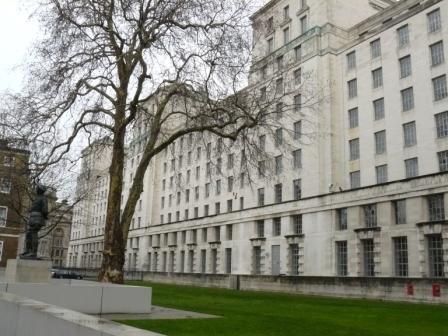
Oh, old Monty – seen here (3rd pic) in a statue close to the UK’s Ministry of Defense (2nd pic) – , would you trust him if he were to tell you how to fight a war or rather not fight it? Could soldiers serving under the Union Jack (1st pic) in Afghanistan trust him?

Would anyone from Whitehall believe his promises of tax cuts when Britain is almost bankrupt? Won’t voters fear that a hung parliament could severely affect their lives?

[For all the posts on this blog go to/Pentru toate postările de pe acest blog mergi la: Contents/Cuprins]

Saturday, 29 March 2008

The UK, in the eyes of an Afghan taxi driver [UK, în ochii unui şofer de taxi afgan]

In order to balance a bit my disproportionately favourable views of the UK, I guess I should report the opinion of a man from Afghanistan who simply wouldn’t like to live in this country for good.

For the time being, as an engineering student and part time taxi driver, he finds the UK a great place to be, he praises the overall openness and tolerance of the Brits towards foreigners, but he wouldn’t hang around too much here after he graduates.

This is no country where to have a family,” he says, complaining (as the British media) about the huge number of divorces, and the general individualistic attitudes of the people here, that brings about promiscuity, and thus the distintegration of the traditional family model.

And I bet he wasn’t refering exclusively to the Brits, but to any people (from any corner of the world) drawn to the mirage of UK capitalism, who lose sight of what’s most valuable in life, in order to be part of this economic success story.

I assume that he could find a wife within the Afghan expat community, however, he wants to raise a family in his own country. No, he didn’t seem insane to me for not being afraid or fed-up with the war in his native country, “because there have been wars ever since I was born”.

As for poverty?,” I asked. He doesn’t fear it either, and would only work for about a year in the UK, but not to save money as I assumed. He wants to gain professional experience that would help him in Afghanistan.

Apart form the people here being “too materialistic”, neither he likes the British food, which he finds much better in the barren Aghanistan, “because everything you eat there is from someone’s garden, not from supermarkets”. I happen to have nothing against the food; I admit that it’s tastier on the Continent, but I can eat whatever I find here.

As for the people in the UK, in spite of the fact that I observe the same things as this Afghan guy, I don’t find them neither more secular than Romanians I work and live among in Romania, nor do I think this is unchangeable.

My dear Orthodox brothers met here prove to me that the Kingdom of God is indeed within our hearts, and that all men can change, anyone can be saved, whilst our Lord Jesus Christ can be found anywhere.

Nevertheless, this student – in his early twenties I presume, speaking perfect English, and with a very neat appearance, contrary to whatever prejudice about the Afghans, we, the civilised ones (?!) might have – really shames me, along with other fellow countrymen who often find ourselves complaining about “tough times” in Romania.

Here’s a man coming from a severely impoverished Muslim country, who has what I would call a healthy outlook on life. Unlike him, I’m hearing about Romanians planning to leave Italy and Spain to come here in the UK, in order to gain more.

But let us all (I include myself), think a bit from this man’s perspective – is there really much to gain, and at what cost, since a man from Afghanistan believes there’s nothing worth leaving his country?

[Pentru toate postările de pe acest blog mergi la/For all the posts on this blog go to: Contents/Cuprins]