Showing posts with label Paris. Show all posts

Friday, 7 September 2012

Lay monuments pointing at the sky [Monumente laice arătând către cer]

Isn’t is fascinating to witness that most (if not all) secular societies’ monuments are still pointing at the sky?

Even after scrapping the idea of divine authority over the earth and distancing themselves from the very concept of God (deemed as obsolete, backward, useless today etc) people are looking up to the visible skies and beyond.

Fewer and fewer are those drawn to Christ’s love, while more and more are those eager to welcome aliens descending from UFOs.

Nevertheless, all people (religious or self-worshipping irreligious), from all places and all ages, have always been secretly yearning for some kind of salvation from a world whose progress has only put and tightened a noose around our necks.


Cathedrals and churches are still towering cities in many countries of the Old Continent (most of which is part of the secular EU).


Some are abandoned ruins (see pics from Scotland here or here), others are turned into cafés or stores, however, they are still here with us, getting in the way of those who banished from God their minds and reject His natural laws.


People can’t live without a certain innate aspiration to verticality, can they? Hardly any monumental work of art could express greatness horizontally. 


Followed either legitimately (“I am the Way, the Truth, the Life”) or illegitimately (through an anthropocentric Tower of Babel), this upward aspiration is inherent in human nature. 

[For all the posts on this blog go to/Pentru toate postările de pe acest blog mergi la: Contents/Cuprins]

Monday, 25 June 2012

[EN] No comment / [RO] Fără comentarii (33) – Tasteless fruits / Fructe fără gust

[EN] As perfectly rounded as wax fruits, but often tasting like moist cardboard. [RO] La fel de perfect rotunjite precum fructele de ceară, dar adesea având gust de carton umed.

[EN] Strawberries, kiwis and grapes... all with the same imprecise taste. [RO] Căpşuni, kiwi şi struguri... toate cu acelaşi gust imprecis.

[EN] Appealing colours, absent flavours, disappointing tastes. [RO] Culori atrăgătoare, arome absente, gusturi dezamăgitoare.

[EN] The same industrial fruits in London, as in Washington DC, Paris or Istanbul... [RO] Aceleaşi fructe industriale la Londra, precum în Washington DC , Paris sau Istanbul...

[EN] (A pleasant exception – the fruits I ate in Portugal’s capital, Lisbon.) [RO] (O plăcută excepţie – fructele pe care le-am mâncat în capitala Portugaliei, Lisabona.)

[EN] No wonder that today’s children don’t like fruits. [RO] Nu-i de mirare că nu le plac fructele copiilor de azi.

[EN] They are more likely to see cloned mamouths in their lifetime than the good fruits of yore. [RO] Mai probabil vor vedea mamuţi clonaţi în timpul vieţii lor decât fructele bune de odinioară.

[EN] Not knowing what they are missing, they may be happy to live in these progressive times. [RO] Neştiind ce pired, or fi fericiţi că trăiesc în aceste vremuri progresiste.

[For all the episodes of this series, and all the posts on this blog go to/Pentru toate episoadele din această serie şi toate postările de pe acest blog mergi la: Contents/Cuprins]

Wednesday, 6 June 2012

Brussels, the European capital of begging? [Bruxelles, capitala europeană a cerşetoriei?]

Far from being ugly, Brussels probably isn’t  one of the first five most beautiful European cities, nor the biggest, either in terms of area, demographics or economic strength.

Yet it is one of the most politically influent cities in the world, as capital of the EU and headquarters of NATO. Sadly, it may deserve another not-so-flattering title.

It’s a sort of secular Mecca, except for the fact that the 500 million Europeans don’t have a religious duty to visit the ‘European shrines’.

As European citizens and taxpayers, they have the right to visit the EU’s institutions, mainly the European Parliament.

On the other hand, for all those exerting political power anywhere in Europe (at national, and sometimes even local level), visiting Brussels is compulsory.

For those in charge of a government, an important municipality, a big region, governing with their backs turned on Brussels has become impossible.

Not less than 75 to 85% (+ here, here) of the laws affecting every European’s life are fully enforced (as regulations) or initiated (as directives) from Brussels.

The fact that the process of turning a proposal of the European Commission into a legislative act passes through Strasbourg one week per month is irrelevant.

Big decisions are taken in Brussels, and the world’s largest corporations, best consultancies, professional associations or NGOs are pretty aware of that. 

It appears that around 3,000 such EU Affairs interest groups spend 158 million euro per year only on communication.

But that’s the glamourous part of Brussels and a deceptive indicator of the (presumably prosperous) state of the Union.

Beyond this glorious image, there’s a less appealing one that hasn’t ever struck me in other big cities of the world.

What cannot evade the eyes of tourists (even the richest ones, travelling by limousine) in the European capital is the number of beggars and homeless people.

With the exception of Bucharest, I haven’t seen as many beggars as in Brussels anywhere else in the world.

I didn’t see that many neither in London, nor in Paris, Berlin etc, and I hardly noticed any in Washington, DC.

One wouldn’t see beggars (only protesters – but that’s a different matter) near the White House, (Washington, DC) or Buckingham Palace (London).

Nevertheless, they are omnipresent near the European Commission (pics 3, 6), the European Parliament (pic 9) and Justus Lipsius building of the EU Council (pic 1).

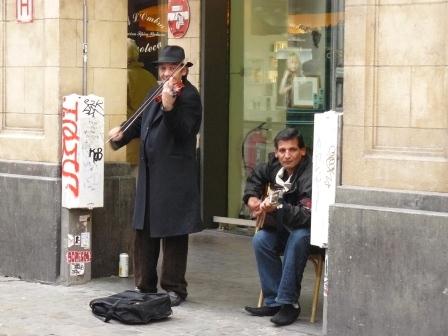
They are not the ingenious street buskers seen in other cities but relatively lousy players (= beggars) who wish to have their ‘performances’ rewarded by passersby.

As long as all important companies want to be seen in Brussels and try to have a say in the intricate EU legislative process, why wouldn’t the begging industry do the same?!

The saddest thing is that many of these destitute people – its arguable if begging is profitable or not – use Romanian to swear at photoholics like me :-(

[For all the posts on this blog go to/Pentru toate postările de pe acest blog mergi la: Contents/Cuprins]

Wednesday, 9 May 2012

Goodbye, rightist hypocrite! Welcome, leftist hypocrite! [La revedere, ipocrit de dreapta! Bun venit, ipocrit de stânga!]

Another swellhead hypocrite – who is convinced of having saved France as much as Gordon Clown dreamt of having saved the world – exits the stage. To no one’s surpise, not even his…

The promised surprise in the run-off election didn’t happen. Thus, Nicolas Sarkozy must step down, leaving his conterparts in the USA, EU, and NATO wondering about the future.

How and to what extent would France change under a Mr Normal’ type of president, as François Hollande describes himself?

Under Sarko ‘the extravagant’, things worked out pretty well for the American (+ NATO) and German (+ EU) interests. Or, at least, everything was predictable.

On the one hand, Sarkozy indebted the country as no other before him – both as minister for Budget (1993-1995) and as President (2007-2012).

On the one other hand, he prescribed the same inane panacea – austerity. In mild doses for France, in deadly doses for Greece.

There’s nothing unusual about this hypocrisy. Excessive spending followed by excessive austerity are irrational only from the perspective of the taxpayer.

For those who decide them and their wealthy friends (from Paris or elsewhere), these apparently irreconcible policies surely have profitable reasons.

And here comes Hollande, a kind of accidental president. As lacklustre as John Kerry in the US presidential election of 2004, yet certainly luckier than him.

Dominique Strauss-Kahn’s philandering made François Hollande the new president of France. Only fanatical leftists could outline other merits of his.

As for wacky promises, he’s as good at selling them as others. He said he would tax by 75% all incomes over 1 million euros a year.

That’s second only to the 100% tax on incomes over 360,000 euros envisaged by Jean-Luc Mélenchon, the Trotskyst candidate.

It’s possible that this is but typical electoral campaign crap, however, does Hollande have any viable solutions to back up his ‘no more austerity’ slogan?!

[For all the posts on this blog go to/Pentru toate postările de pe acest blog mergi la: Contents/Cuprins]

Saturday, 3 December 2011

Will the Eurozone crack? [Va crăpa Eurozona?]

More than three years after the Wall Street Crash of 2008, the unthinkable demise of the euro and the break-up of the Eurozone has (apparently) become plausible.

It’s getting crystal clear even to the most fanatic euroenthusiasts that any imminent economic cataclysm cannot be blamed on convenient scapegoats anymore.

The lazy Greeks, the irresponsible governments in Eurozone weak links countries (PIIGS), along with greedy bankers everywhere may have played relatively secondary roles in influencing the destiny of the EMU.

Nevertheless, the fate of the European currency has never been – nor is it in these very days of turmoil – in the hands of less important actors like the above.

The devil lies in the details of EU treaties and especially in the chain of misdeeds committed by the political leaders of Europe, whether acting unilaterally, from Berlin, Paris or Rome, or together, from Brussels.

Hardly could the roots of the current crisis be located in Frankfurt, as the ECB has seldom had its hands united by the heads of state and government reunited in the Council of the Union.

More and more independent economists show that the mess engulfing the EU and threatening to blow up the global economy has systemic causes.

The EMU is on the brink of disaster because it lacks several fundamental premises of an efficient monetary union; it is made up of an econimic ‘giant’ (Germany) with 16 ‘feet of clay’ of various strengths from stronger (France) and weaker (Italy) muscles to negligible appendices (Estonia).

The ECB could be reasonably functioning as a central bank (if allowed to act do so), yet there is no effective equivalent of a national Treasury (Ministry of Finances) or Government in Brussels.

For decades, EU leaders have been deploring the lack of a common defence policy (greatly compensated by NATO) or of a common energy policy (whose absence contributes to the fact that Europeans are often ‘energy hostages’ of Russia).

It was fashionable to complain about these issues, however, none was as divisive and able to threaten the survival of the EU as the other skeleton that the current crisis took out of the Union’s closet – there is no common fiscal policy of the EMU.

In its absence, sooner or later, the Eurozone would be doomed to crack, like some analysts anticipated in the late 1990s, if not even longer before, around the dawn of this project.

The flaws of the EMU were known from the very beginning but swept under a carpet of great expectations about increased common prosperity.

For a while, the illusion worked. After the first months of wariness, when many Europeans in euro countries were shocked by price hikes, almost everyone grew accustomed with a stable currency, no need for exchange rates, low inflation and bearable interest rates.

The Greeks, Spaniards, Portuguese and others had access to cheap credit, while their tourist industries cashed in strong euros, instead of weak drachmas, pesetas or escudos.

In the meantime, the euro was weaker than how the Deutsche Mark would have probably been in the 2000s, enabling Germany to be biggest world exporter in 2007, ahead of China.

The success story seemed complete, and many warnings (like the ones about Italy being unfit for EMU membership (+ here, here, here) – see the pics*** illustrating this article!) were bluntly dismissed as nonsensical soothsaying.

Actually, there’s growing evidence that it was well-known to the architects of the euro that the Eurosystem was ill conceived from the start.

This didn’t prevent them from taking a huge gamble on the hope that a severe crisis (like the one the world has endured since 2008) would eventually help establish a “a more perfect union,” like the Constitution of the USA aimed in 1787.

Is this imperfect monetary union perfectible? Are the 17 euro countries willing to take upon themselves the full political cost of making the EMU truly functional?

And could giving up more of one country’s sovereignty guarantee anything for the EU’s citizens (“we the people,” if we were to quote the US Constitution again), apart from helping save the banking system from collapse?

Will a ‘full fiscal union’ work better than the current ailing EMU? The Eurosystem would probably run smoothly, yet the imbalances between the 17 economies would remain as grave as they are today, if not even worsen.

Smothering public deficits from the cradle would not grant choices of more responsible political leaders to European voters; it would merely ignite more vicious political battles and maybe even class conflict within nations.

And, riskier than anything else, wouldn’t this ‘EU Treasury’ remain as unaccountable to European citizens as other EU institutions and leaders that created the current ‘euro-mess’ have always been?

[For all the posts on this blog go to/Pentru toate postările de pe acest blog mergi la: Contents/Cuprins]

*** NOTE: Simon Tilford, from the Center for European Reform (London based think-tank), warned that “if Italy fails to improve its competitiveness, it will eventually have to leave the Eurozone” (2006).

Monday, 24 October 2011

Din raidurile mele prin inima Scoţiei (23) [From my forays into Scotland's heartland]

De cum le-am descoperit, am lăudat suvenirurile din Londra, ca fiind un pic cu mai multe plusuri decât minusurile pe care le găseşti la astfel de obiecte în alte părţi ale lumii.

Iată că aşa s-a nimerit ca, după mai multă vreme, să apuc să le laud şi pe cele găsite în Edinburgh, un ‘oraş-acasă-ideală’ vizitat de trei ori până acum.

La fel ca în Londra sau în orice altă capitală a lumii (inclusiv în Washington DC, Paris, Roma sau Berlin!), mai dai şi aici peste suveniruri made in China’.

Ba chiar am aflat şi m-am grăbit să cumpăr (pentru inscripţiile cu Scotland şi drapelul cu Crucea Sf. Andrei) şi peste nişte tricouri  made in Haiti’ (poza 5).

Mare ţeapă am luat, căci deşi erau de bumbac 100% (şi după ce scria pe etichetă, şi la atingere), aveau o duhoare de parcă ar fi fost produse într-o tăbăcărie :-(

Aceasta a fost singura experienţă negativă. Restul suvenirurilor văzute, pipăite şi cumpărate au fost toate de nota zece.

Mai ales cele cu adevărat made in Scotland’, din lână locală (plovăre, fulare, căciuli, fuste, şepci etc), sau biscuiţii de ovăz (4) – şi gustoşi, şi buni pentru digestie.

De la deja clasicele brelocuri şi magneţi de frigider (3) sau căni (2) până la rechizite cu însemne scoţiene (1), toate mi-au plăcut.

Iar acestea erau, în mare, lucrurile de găsit pretudindeni în oraş, pe când cele mai bune suveniruri (dar şi mai usturătoare ca preţ) se găsesc la Edinburgh Castle.

Oferta este foarte bogată, toate produsele sunt, efectiv, realizate în Scoţia, dar şi de o calitate care îşi merită banii şi nici nu te face de râs dacă îţi decorezi casa cu ele.

Astfel de obiecte chiar frumoase, nu doar bune de a te da mare că le ai din Scoţia sunt tapiţeriile tradiţionale (6), mai interesante decât clasicele Răpiri din Serai :-) zic eu...

Dacă nu-ţi permiţi una de perete, te poţi mulţumi cu o faţă de masă sau semn de carte (9) sau cu un joc de şah (10), deşi destul de costisitor (£ 50).

Faţă de cănile de duzină din oraş, la castel găseşti unele şi mai frumoase, şi de 4-5 ori mai scumpe (13).

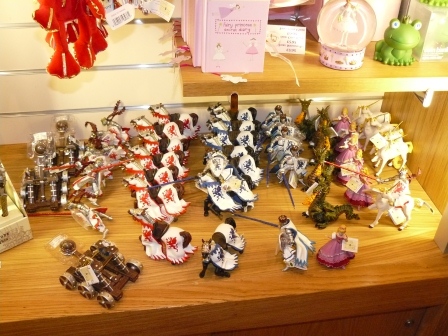
Mai poţi cumpăra cărţi de joc cu imagini din Scoţia (14) , bijuterii (12), săpunuri (13), săbii şi diademe pentru copii (8) şi jucării pentru colecţionari de toate vârstele (7).

[Pentru toate episoadele din această serie şi toate postările de pe acest blog mergi la/For all the episodes of this series, and all the posts on this blog go to: Contents/Cuprins]