Showing posts with label Theotokos. Show all posts

Wednesday, 31 July 2013

Cea mai fericită femeie [The happiest woman]

Noi i-am ucis Fiul, dar ea ne iubeşte. A suferit mai mult decât toate femeile*** care s-au născut şi se vor naşte vreodată pe lume.

Miliarde de fiice ale Evei au îndurat şi vor mai avea parte de chinuri cumplite, însă numai uneia i s-a prezis că va trece sabie prin sufletul său. Şi aşa a fost.

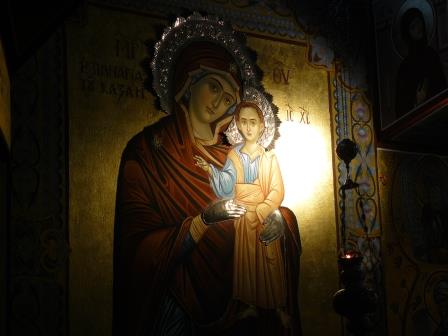
Totuşi, pe niciuna alta nu o putem numi pururea fericită. Numai Preasfânta Născătoare de Dumnezeu (Theotokos) este şi cea care a suferit mai mult, dar şi cea mai fericită.

Cum de uităm adesea această esenţială lecţie?! Nu există nici scurtături către fericire, nici nu o putem atinge pe gratis, fără a ne asuma un preţ.

Iar pe acesta nu-l puteam măsura în bani sau în funcţie de alte repere materiale după care, eronat, ne rânduim vieţile.

Atât în lumea trecătoare de aici, dar mai ales când se vor socoti toate, în cea de apoi, nu vom primi decât atâta autentică fericire câtă dispoziţie pentru jertfă am avut. 

Or, cine va avea vreodată mai multă jertfelnicie decât Maica Domnului? Toţi sfinţii sunt bune modele, dar unul este modelul suprem.

Dacă până şi jalnicele surogate hedoniste pe care le luăm drept fericire ne costă şi ne dor, cum ar putea fericirea veritabilă să ne vină de-a gata?

Nu că nu ne-ar da-o Dumnezeu, că doar Adam şi Eva astfel au primit-o. Dar nu ne-ar fi de folos. Am strica-o precum au făcut protopărinţii noştri.

Mulţi copii se roagă să primească jucăria preferată, o visează noaptea, îşi fac speranţe, mai bat din picior sau se fac surprinzător de cuminţi mânaţi de acest interes.

Într-un final, îşi primesc cadoul râvnit. Însă nu ştiu ce să facă de el. Adesea, nici nu trece o jumătate de oră până ce ajunge să zacă stricat în vreun colţ al casei.

Oricui şi oricând ne-ar da Dumnezeu fericirea instantaneu. Dar nu ne-ar fi de niciun folos. N-am şti să preţuim ceea ce, fiind un dar divin, este fără-de-preţ.

Nu se pune problema că nu o merităm, căci fără de merit ne-a chemat Preasfânta Treime de la nefiinţă la viaţă – pentru veşnică şi deplină fericire.

Ci doar că nu ştim să trăim fericirea. Prin urmare, Domnul ne poartă prin împrejurări smeritoare, doar-doar om învăţa să preţuim darul la care ne cheamă.

În mod ideal, de am ţine toate poruncile lui Hristos, am trece prin viaţă fără durere, căci în faţa fiecărei răscruri am avea deja lecţia învăţată.

Pentru că nu ne ţinem de porunci, dar Domnul tot ne vrea fericiţi alături de El, primim întâi teste (felurite necazuri, încercări, ispite, dureri), apoi lecţiile şi tot aşa.

A ne lăsa în voia Lui (Iată roaba Domnului...”), clipă de clipă, este calea desăvârşită către fericire. Ceea ce nu ne garantează că nu vom avea o cruce de purtat.

Încă dinainte de a zămisli şi a deveni Maică a lui Dumnezeu, Fecioara Maria respecta toate poruncile, dar chinuri fără seamăn tot n-au ocolit-o.

Aceasta pentru a ne fi tuturor lecţie să nu deznădăjduim. Dacă ea, curată fiind, nu a deznădăjduit în faţa Crucii, nici noi să nu deznădăjduim vreodată!

Ştiindu-ne atât de pângăriţi, să nădăjduim că oricâte rele am îndura, pentru păcatele noastre ne vin, ca să ştim a preţui fericirea alături de Făcătorul nostru.

Din mulţimea păcatelor şi departe de Sf. Împărtăşanie fiind (din neglijenţa noastră sau opriţi de duhovnic), uneori ne pierdem îndrăzneala către Mântuitorul.

Cu toate acestea, şi din cea mai adâncă deznădejde, să o chemăm pe Maica Sa. Minunile ei nu-s doar în cărţi, ci se petrec acum în multe vieţi din jurul nostru.

Să nu credem minţii noastre nici în plăsmuiri feerice, nici în deznădejde, ci să nu lăsăm vreo zi fără o chemăm pe Maica Domnului. Şi vom trăi minuni!

*** NOTĂ: Dedic acest articol surorilor în Hristos care s-au aflat în Tabăra aniversară a Asociaţiei Ortodoxia Tinerilor (Borşa, MM, 23-29 iulie 2013), cu îndemnul de a se strădui mai mult să se apropie de Maica Domnului. Nu există o reţetă de fericire mai bună.

[Pentru toate postările de pe acest blog mergi la/For all the posts on this blog go to: Contents/Cuprins]

Tuesday, 28 May 2013

Yearning for a return to Holy Mount Athos [Dor de o întoarcere în Sfântul Munte Athos]

Billions of people living on earth may have never heard of this place, although they may owe their lives to the prayers rising without cease to the Lord from there.


Out of the much fewer people who are aware of Holy Mount Athos’ existence, many may have diverging opinions. They are far from understanding what it is.


At best, some found it fit to give it as an example of an unique cultural heritage of humanity and make it a topic of an international conference reaching its third edition in 2013.


Some see it merely as a historic relic, a monastic republic with a special autonomous status within Greece, which shouldn’t burden the country’s budget anymore.


Others see it as an outpost of gender segregation, as women have not been officially allowed on the peninsula since 1060. Actually, the ban was a few centuries old by then.


Anyway, not a human law, but the Most Holy Mother of God (Theotokos) was the one who forbade the entry of women in this spiritual oasis reserved to men.


Beyond truncated perspectives like the above, Holy Mount Athos is incomprehensibly more than just a physical place, it’s a trancendental reality, a gateway to the Kingdom of God.


Every day, and especially every night, mankind (not just the Orthodox believers) is kept alive by the prayers of the fewer than 2,000 monks living on this Holy Mountain.


It’s not the sort of comforting prayer for those who have already been striken by misfortunes, but the kind of prayer preventing bad things to happen to our gone mad world.


To our secular contemporaries this makes no sense. How could prayers – seen as nothing more than meaningless words sent to a hypotethical God – actually work, they ask?


For me, all three things that I had been told about the Holy Mountain before visiting it appear to have already come true or are in the process of turning into reality…


First: one visit is not enough to understand such a realm where the earth briges the sky; no matter how much you discovered, you’d still feel that there’s so much more to find out.


Second: equally true was the warning that, after having set foot there once, you’d be yearning for another visit. And another, and another, and another…


Third: implacably, as soon as you get there, you’re off for a life-changing experience. Although this change may not happen instantaneously, it will certainly come.


Even if it were to take years before fully sprouting in your heart – assuming you’re not totally heartless – you can’t avoid the feeling that change (hopefully for the better) is on the way…

[For all the posts on this blog go to/Pentru toate postările de pe acest blog mergi la: Contents/Cuprins]

Thursday, 8 September 2011

God’s place in a humanist society (19) [Locul lui Dumnezeu într-o societate umanistă]

I assume that it’s no surprise to any constant reader of this blog that, from a religious point of view, I saw Brighton as being a sort of ‘spiritual flea market’ – all choices available for the weirdest of ‘consumers’ (see here or here).

One such choice is this so-called Religious Society of Friends, a self-proclaimed Christian (?!) movement, whose members are better known as Quakers.

I haven’t personally met any believer, and even if I had done so, I should refrain from judging that person. Which won’t prevent me from dimissing this heresy, made up of a concoction of beliefs as far from Christ’s message as any other ‘man-made’ religions.

Fed up with the disarray and countless moral flaws within the Church of England (CoE), as well as with the brutality of the English Civil War in Oliver Cromwell’s troubled times, these ‘friends’ came up with some simple and appealing ideas.

Humans need no priest between them and the Lord, no ordained and paid clergy, neither an ‘established Church’, the founder of the sect (George Fox) said.

Guided by ‘inner voices’ (Orthodox Holy Fathers give a precise diagnosis reagarding whose voices are these), Fox claimed that, instead of ‘organised religion’, what matters is the ‘inner light’ that believers in Christ can find in themselves.

They may speak on His behalf, however, they surely don’t know Christ, as they don’t revere – like most Protestant denominations – the Mother of God (Theotokos) whose birth we are celebrating today.

There’s no proper understanding of Salvation without understanding the Theotokos’ unique role in God’s plans. No one can be ‘attracted’ to Christ and remain ‘indifferent’ to His Mother.

Anyway, I could’t have anything against these people – only the Lord will judge each of us. At least these ‘friends’ are pacifists (refusing to take arms and swear oaths), their ‘services’ consist of mostly silent meetings, and some of their ancestors were victims of cruel acts perpetrated by other self-entitled Christians.

To the extent they are living by their convictions (although there is no Quaker ‘creed’ at all; there are only some books used for guidance) , they seem to be harmless, unlike many aggressive sects.

What I find worthy of considerations are the troubled times that would determine George Fox to channel his frustrations towards creating this sect.

When Fox began preaching (1647), there had been 581 years since 1066 (Norman Invasion of England), and 593 since the Great Schism. In its death throes today, the CoE was already in a grave condition back then.

The Church of England could have been shredded to pieces – because of the many English Dissenters – had it not been for the Civil War, for Cromwell’s iron grip on power, and for the fact that most of these sects would eventually move (forcibly or by their choice) to the New World.

Not that I’d agree with the harsh methods used against them, but we must acknowledge the fact that, some 350 years ago, English Dissenters could be easily silenced by the state religion.

Today, any dissenter within the CoE would be granted protection by the secular and politically correct state. It often happens that this ‘church’ changes for the sake of the dissenter.

In the meantime, from the outside of this ailing organisation, Anglicans in the UK are steadily being out numbered by Muslims, while all religious people would be soon a minority in a country where irreligiousness is valued positively, and religion is frowned upon.

Social and political turmoil, festering in a swamp of consumerism, make up the ideal habitat of false prophets like George Fox.

Most people today prefer to dive deeper into the mire, using these false prophets as evidence for their “there’s-no-God-but-my-own-will” creed. Few take comfort in the deceitful peace and meanings of sects, which keep mushrooming like in 17 century England.

Even fewer throw themselves into the arms of the Mother of God, knowing what path (the Royal Path of Orthodoxy) to take towards her.

As long as even our Saviour nestled in her arms, that should be the safest place to put one’s soul in these mad times. 
.
[For all the episodes of this series, and all the posts on this blog go to/Pentru toate episoadele din această serie şi toate postările de pe acest blog mergi la: Contents/Cuprins]