Showing posts with label London. Show all posts

Monday, 30 September 2013

[EN] Political promises / [RO] Promisiuni politice

[EN] Two pics from clean cities like Edinburgh and London. [RO] Două poze din oraşe curate precum Edinburgh şi Londra.

[EN] Is there anyone as naive as to disagree with the words added to the images? [RO] Există cineva atât de naiv, încât să nu fie de acord cu vorbele adăugate pe imagini?

[EN] Is there anything that could change our opinion? [RO] Există ceva care ne-ar schimba părerea?

[EN] I don’t believe in revolutions making politicians swallow their words. [RO] Nu cred în revoluţii care să-i facă pe politicieni să-şi înghită cuvintele.

[EN] Nor do I advise trusting any political saviour.  What did Obamania achieve? [RO] Nici nu sfătuiesc a crede în vreun mântuitor politic. Ce a realizat Obamania?

[EN] I just want to say that, though painful, nothing is as liberating as telling the truth. [RO] Vreau doar să zic că, deşi dureros, nimic nu este mai eliberator decât a spune adevărul.

[EN] To the secular, I give a quote attibuted to George Orwell: [RO] Celor seculari, le dau un citat atribuit lui George Orwell:

[EN]In times of universal deceit telling the truth becomes a revolutionary act[RO]În vremuri de amăgire universală a spune adevărul devine un act revoluționar”  

[EN] To the believers, I remind Lord Jesus Christ’s words: [EN] Celor credincioşi le reamintesc cuvintele Domnului Iisus Hristos:

[EN]You will know the truth, and the truth will make you free[EN]Veţi cunoaşte adevărul, iar adevărul vă va face liberi

[For all the posts on this blog go to/Pentru toate postările de pe acest blog mergi la: Contents/Cuprins]

Monday, 24 September 2012

[EN] A few wonders from the UK / [RO] Câteva minunăţii din UK (30)

[EN] The tallest observation wheel in Europe. [RO] Cea mai înaltă roată de observaţie din Europa şi a treia cea mai înaltă din lume.


[EN] At 135 meters, it’s also the third tallest in the world. [RO] La 135 de metri, este şi a treia cea mai înaltă din lume.


[EN] The biggest – in Singapore. The second – in China. [RO] Cea mai mare – în Singapore. A doua – în China.


[EN] London Eye – an iconic brand of London, like the Big Ben. [RO] London Eye – o marcă iconică a Londrei, precum Big Ben-ul.

 
[EN] Also near the river Thames, but on the opposite bank. [RO] Tot lângă râul Tamisa, dar pe malul opus.


[EN] Pictures taken soon before and after sunset on a warm February day. [RO] Fotografii făcute curând înainte şi după apus, într-o zi caldă de februarie.

[For all the episodes of this series, and all the posts on this blog go to/Pentru toate episoadele din această serie şi toate postările de pe acest blog mergi la: Contents/Cuprins]

Sunday, 23 September 2012

Chestii d-astea, numai la britanici (37) [Things like these, only at the Brits]

Pentru o liră (£ 1), dintr-unele toalete publice din UK (la Londra, acum s-of fi răspândit) puteai cumpăra astfel de periuţe de dinţi, nu tocmai comestibile, dar cu siguranţă... mestecabile.

Pusă într-o biluţă de plastic, o gumă de mestecat în formă de periuţă cu mâner (Fuzzy Brush) îţi promite curăţarea dinţilor şi împrospătarea respiraţiei.


Interesanta idee s-a născut în Ţările de Jos (la Amsterdam), a călătorit prin Australia, dar avea să devină o afacere de succes în... Anglia. 

În 2008, cică fuseseră deja vândute 70 de milioane de bucăţi, mai ales în UK, SUA, Canada, America de Sud, Asia etc... Oare se vinde şi prin România?!

[Pentru toate episoadele din această serie şi toate postările de pe acest blog mergi la/For all the episodes of this series, and all the posts on this blog go to: Contents/Cuprins]

Friday, 7 September 2012

Lay monuments pointing at the sky [Monumente laice arătând către cer]

Isn’t is fascinating to witness that most (if not all) secular societies’ monuments are still pointing at the sky?

Even after scrapping the idea of divine authority over the earth and distancing themselves from the very concept of God (deemed as obsolete, backward, useless today etc) people are looking up to the visible skies and beyond.

Fewer and fewer are those drawn to Christ’s love, while more and more are those eager to welcome aliens descending from UFOs.

Nevertheless, all people (religious or self-worshipping irreligious), from all places and all ages, have always been secretly yearning for some kind of salvation from a world whose progress has only put and tightened a noose around our necks.


Cathedrals and churches are still towering cities in many countries of the Old Continent (most of which is part of the secular EU).


Some are abandoned ruins (see pics from Scotland here or here), others are turned into cafés or stores, however, they are still here with us, getting in the way of those who banished from God their minds and reject His natural laws.


People can’t live without a certain innate aspiration to verticality, can they? Hardly any monumental work of art could express greatness horizontally. 


Followed either legitimately (“I am the Way, the Truth, the Life”) or illegitimately (through an anthropocentric Tower of Babel), this upward aspiration is inherent in human nature. 

[For all the posts on this blog go to/Pentru toate postările de pe acest blog mergi la: Contents/Cuprins]

Wednesday, 18 July 2012

What makes Russia ‘great’ and what ‘belittles’ Great Britain [Ce face Rusia ‘mare’ şi ce ‘micşorează’ Marea Britanie]

Gone are the days when Napoleon Bonaparte was fearing Russia for being “the continental sword of England,” and so are the days when Winston Churchill’s Britain had to make use of the USSR as a continental sword against Nazi Germany.

Today, a general mistrust – whether polite or sarcastic at times – reigns over the relations between London and Moscow. The reasons for that are not entirely obvious.

London is no longer backing a moribund Ottoman Turkey against Tsarist Russia, nor is it offering a safehaven to thousands of White Russians, fleeing from the onslaught of Bolshevik Communism.

Neither are Britain’s and Russia’s conflicting interests in Asia so vivid as they were in 19th century, as there are is no British, nor Russian empire left.

The British armed forces are in their 10th year of what could be called a ‘Fourth Afghan War’, while London’s and Moscow’s views on Iran differ, but there’s no Great Game being played anymore. No longer British, India is rather close to Russia.

Therefore, why are Britain  and Russia are on so irreconcible terms these days?

--- --- --- --- --- --- --- --- --- --- --- ---

Of course that, beyond my above hypersimplistic geopolitical analysis, there are enough substantial differences to be found. But there are similarities even within those differences:

[1] Britain’s slow descend into a multicultural dictatorship seems incompatible with the nationalistic dictatorship of Vladimir Putin.

They are both doubtful democracies. The significant difference is that one has always been a democratic pariah, while the other has still got the BBC, which is worth several thousand bayonets, if we look at it from Bonaparte’s perspective.

Maybe Oliver Cromwell was no less of a villain than Ivan the Terrible, but it seems that only the latter’s country would forevermore be labeled as ‘undemocratic’.

On the other hand, it seems utterly inconceivable to put into question the paramount British democracy. Anyone who dares do that would be quickly dismissed as insane…

[2] Britain’s willingness to sell almost anything to foreign investors is different from the fact that Russia’s economy was handed to a bunch of oligrachs that are more ore less controllable (even when they reside in London :-) by Putin.

Either the capital is multinational or national, the sad truth is that both Britons and Russians are no longer in control of their natural resources and national economies.

Both the Communist paradise promised in the USSR or the Welfare State promised in post-WW2 Britain were illusions.

[3] Britain’s Armed Forces are facing one of their toughest enemies ever, the severe budget cuts, while Russia’s Military, in spite of a poorer budget, is rearming.

It would take some time before Russia closes all the technological gaps, however, it will always enjoy an advantage in numbers and strengths.

[4] Britain is not as alone as Russia is. Shielded by NATO membership, and thanks to the English Channel, the Perfidious Albion is relatively safe.

In no possible UK-against-Russia scenario, Britain would be forced to fight alone, as in the summer of 1940. As for Moscow, it has no true friends. Even the strategic partnership with India (a rich buyer of Russian defence equipment) could hardly be considered an alliance.

--- --- --- --- --- --- --- --- --- --- --- ---

Irrespective of visible differences like these, there must be a deeper explanation for the fact that former allies (against antichristic figures like Napoleon Bonaparte and Adolf Hitler) are at odds with each other. Which are those?

Is there a true incompatibility between Russia and Great Britain? At a first glance, there are is a majority of atheists, hedonists, pseudo-Christians and abortionists in both countries…

UK’s population is growing thanks to immigrants (many of whom are Muslim), whilst Russia’s population is in decline because of poverty, corruption, alcohol abuse, which are just the visible effects of a dreadful moral decline.

But while Britain is sinking into a swamp of irreligiousness, at least for some Russians there is hope. There is nothing to hope for in the religion of political correctness of Britain but there’s everything a man needs for salvation in the Orthodox Church.

Just as Stalin did, when he desperately needed to halt Hitler’s panzers’ stunning advance, Putin is using the Orthodox Church as a counterweight to Western influence in his country.

However, he can only use some hierarchs and the human and corruptible side of the Church; neither Putin, nor anyone else could compromise or destroy the Lord’s true Church. None of Russia’s material and political assets are as valuable as the Orthodox faith.

Even after Russia will have lost everything (large territories, control of natural wealth, sovereignty, millions of people) – in a catastrophic world war, for instance – it will still remain one of the richest countries of the world in spiritual terms.

If only the same could be hoped for Britain! The more Britain has achieved in terms of civilisation, the more spiritually barren it is…

For generations, Russians have been accustomed with losing everything, and maybe only the bitterness of another devastating blow in historical terms will help them come to their senses and rediscover the meaningfulness of Orthodoxy.

For Britons, it is very likely that any earthly victory will inflate their delusions, while any defeat will push them into despondency. In either case, they seem doomed, as they’ve got not metaphysical lifebuoy in their inane quest for material prosperity.

[For all the posts on this blog go to/Pentru toate postările de pe acest blog mergi la: Contents/Cuprins]

Monday, 2 July 2012

About public transport in the UK (23) [Despre transportul în comun în UK]

As a foreign observer, I don’t know if going on strike to demand a special Olimpic Games bonus (of £ 500 to £ 700) is reasonable or not, but this is what London bus drivers plan to do.

If you asked a far-from-perfect driver like me, I’d say that all bus drivers are some kind of artists who’d definitely deserve to have their skills and hard work rewarded.

However, thanks to the London Congestion Charge, driving a bus in London seems to be a piece of cake – compared to doing the same thing in Bucharest or, say, anywhere in India.

The only thing that really made the life of british bus drivers harder (in Brighton at least) was the fact that passengers could buy tickets directly from them.

It’s not difficult to imagine what a mess it would be, it tourists from all over the world were able to this during London 2012

How many would carry the right change in their pockets? I’d say that most of them would mostly have 20 GBP banknotes, wouldn’t they?

[For all the episodes of this series, and all the posts on this blog go to/Pentru toate episoadele din această serie şi toate postările de pe acest blog mergi la: Contents/Cuprins]

Tuesday, 26 June 2012

God’s place in a humanist society (23) [Locul lui Dumnezeu într-o societate umanistă]

Not only that they are fewer, but British practicing Christians are more and more pressured to hide their faith, in order to go on enjoying the privilege of living in a democratic, progressive and prosperous country like the UK.

Wearing a cross at work, even exhibiting one in an electrician’s van have become unofficial offences that irreligious zealots are eager to punish.

More and more – of the already few! – Christians in Britain are at risk of being put in front of a stark choice: “Take off your cross or you’ll get sacked!”.

Supervisers, bosses, co-workers or any other politically correct authorities have no scruples about threatening Christians like this, whilst no one would dare asking a Muslim woman to remove her veil, a Jew to take off his kippah or a Sikh to renounce his turban.

Indeed, that would be outrageous in a country like Great Britain, wouldn’t it? But shouldn’t the same laws the same right for Christians?

It seems that the answer is definitely negative, according to the Conservative (?!) Chameleon in office at 10 Downing Street.

For the UK Government, wearing a cross is not a “generally recognised Christian practice,” thus it needn’t be supported by the State in front of the ECHR. In a country where any wacky minority can ask for protection, Christians are defenceless…

Then why is the British monarh still called Defender of the Faith? Why is the Union Jack still bearing not one but three crosses?

And what kind of faith is that which the Monarch defends? The faith that Christianity is a relic of history whose demise should be hastened?!

There’s no doubt that being a Christian has become a deficiency for one’s employability in the UK. Unless you’re a New man, you can hardly integrate in a society obsessed with material wealth and with loathing its Christian heritage.

Just like in the USSR, when politically correct bolsheviks in Britain can’t snatch crosses from people’s hearts by brainwashing, they forcibly take them off chests.

They are probably relying on the fact that those of churches will fall by themselves. If not, one day they will take the cross down even from St. Paul’s Cathedral in the City of London

[For all the episodes of this series, and all the posts on this blog go to/Pentru toate episoadele din această serie şi toate postările de pe acest blog mergi la: Contents/Cuprins]

Monday, 25 June 2012

[EN] No comment / [RO] Fără comentarii (33) – Tasteless fruits / Fructe fără gust

[EN] As perfectly rounded as wax fruits, but often tasting like moist cardboard. [RO] La fel de perfect rotunjite precum fructele de ceară, dar adesea având gust de carton umed.

[EN] Strawberries, kiwis and grapes... all with the same imprecise taste. [RO] Căpşuni, kiwi şi struguri... toate cu acelaşi gust imprecis.

[EN] Appealing colours, absent flavours, disappointing tastes. [RO] Culori atrăgătoare, arome absente, gusturi dezamăgitoare.

[EN] The same industrial fruits in London, as in Washington DC, Paris or Istanbul... [RO] Aceleaşi fructe industriale la Londra, precum în Washington DC , Paris sau Istanbul...

[EN] (A pleasant exception – the fruits I ate in Portugal’s capital, Lisbon.) [RO] (O plăcută excepţie – fructele pe care le-am mâncat în capitala Portugaliei, Lisabona.)

[EN] No wonder that today’s children don’t like fruits. [RO] Nu-i de mirare că nu le plac fructele copiilor de azi.

[EN] They are more likely to see cloned mamouths in their lifetime than the good fruits of yore. [RO] Mai probabil vor vedea mamuţi clonaţi în timpul vieţii lor decât fructele bune de odinioară.

[EN] Not knowing what they are missing, they may be happy to live in these progressive times. [RO] Neştiind ce pired, or fi fericiţi că trăiesc în aceste vremuri progresiste.

[For all the episodes of this series, and all the posts on this blog go to/Pentru toate episoadele din această serie şi toate postările de pe acest blog mergi la: Contents/Cuprins]

Friday, 22 June 2012

Chestii d-astea, numai la britanici (35) [Things like these, only at the Brits]

Cică hrănirea porumbeilor nu este permisă”, avertiza un sobru panou din Kensington Gardens (Londra), unul dintre cele opt parcuri administrate de Royal Parks.

Ba mai şi avertiza că vandalizarea panoului este un delict...

Dar porumbeii nu arătau deloc flămânzi, iar copii (sau părinţi) sancţionaţi pentru încălcarea interdicţiei nu am văzut.

Nu că n-or fi fost, căci ori este posibil în Statul dădacă.

Royal Parks merită toată lauda pentru îngrijirea parcurilor, dar interacţiunea copil-porumbel parcă este o ultimă fărâmă de firesc în lumea noastră artificială.

Şi sunt tot mai puţini copiii ce lasă jocurile video pentru parcuri...

[Pentru toate episoadele din această serie şi toate postările de pe acest blog mergi la/For all the episodes of this series, and all the posts on this blog go to: Contents/Cuprins]

Thursday, 14 June 2012

Poduri pe cer [Bridges on the sky]

Dintre multele curiozităţi cu care am rămas în memorie de prin călătoriile mele, pasarele între clădiri ocupă un loc aparte.

Mai întâi, pentru că în România sunt atât de neobişnuite. Cred că cele din Bucureşti se pot număra pe degetele unei mâini.

Apoi, pentru că iarăşi îmi oferă prilejul de a pune pe MunteanUK o mostră din abundenţa lexicală a limbii engleze.

Li se zice skyways, catwalks, sky bridges, skywalks (mai ales în SUA), fiind considerate tipuri particulare ale termenului generic pedways.

În română nu am găsit alt echivalent decât pasarele. Poate o fi pleonasm să zici pasarele suspendate. Sau nu?!

Imaginile acestor căi pietonale aeriene au fost surprinse de cititoarea mea C.L. în Covent Garden, Londra (1) şi de mine, în Glasgow (2), respectiv Edinburgh.

Mai răspândite sunt în Canada şi statele cu ierni aspre din nordul SUA (în Iowa am văzut o grămadă), din două motive principale.

Pentru a asigura fluiditatea traficului în oraşe care nu prea au trotuare şi pentru a-i feri pe pietoni de gerurile năpraznice şi împotmolirea în nămeţi.

Ar fi practice şi în prea aglomerata capitală a României? Ar fi şi estetice? Se poate zice că dau bine între zgârie nori, dar nu ştiu dacă şi între clădirile fostului Mic Paris

[Pentru toate postările de pe acest blog mergi la/For all the posts on this blog go to: Contents/Cuprins]

Wednesday, 6 June 2012

Brussels, the European capital of begging? [Bruxelles, capitala europeană a cerşetoriei?]

Far from being ugly, Brussels probably isn’t  one of the first five most beautiful European cities, nor the biggest, either in terms of area, demographics or economic strength.

Yet it is one of the most politically influent cities in the world, as capital of the EU and headquarters of NATO. Sadly, it may deserve another not-so-flattering title.

It’s a sort of secular Mecca, except for the fact that the 500 million Europeans don’t have a religious duty to visit the ‘European shrines’.

As European citizens and taxpayers, they have the right to visit the EU’s institutions, mainly the European Parliament.

On the other hand, for all those exerting political power anywhere in Europe (at national, and sometimes even local level), visiting Brussels is compulsory.

For those in charge of a government, an important municipality, a big region, governing with their backs turned on Brussels has become impossible.

Not less than 75 to 85% (+ here, here) of the laws affecting every European’s life are fully enforced (as regulations) or initiated (as directives) from Brussels.

The fact that the process of turning a proposal of the European Commission into a legislative act passes through Strasbourg one week per month is irrelevant.

Big decisions are taken in Brussels, and the world’s largest corporations, best consultancies, professional associations or NGOs are pretty aware of that. 

It appears that around 3,000 such EU Affairs interest groups spend 158 million euro per year only on communication.

But that’s the glamourous part of Brussels and a deceptive indicator of the (presumably prosperous) state of the Union.

Beyond this glorious image, there’s a less appealing one that hasn’t ever struck me in other big cities of the world.

What cannot evade the eyes of tourists (even the richest ones, travelling by limousine) in the European capital is the number of beggars and homeless people.

With the exception of Bucharest, I haven’t seen as many beggars as in Brussels anywhere else in the world.

I didn’t see that many neither in London, nor in Paris, Berlin etc, and I hardly noticed any in Washington, DC.

One wouldn’t see beggars (only protesters – but that’s a different matter) near the White House, (Washington, DC) or Buckingham Palace (London).

Nevertheless, they are omnipresent near the European Commission (pics 3, 6), the European Parliament (pic 9) and Justus Lipsius building of the EU Council (pic 1).

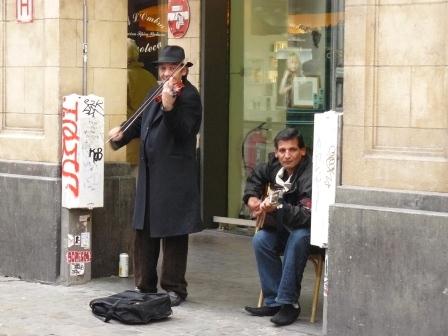
They are not the ingenious street buskers seen in other cities but relatively lousy players (= beggars) who wish to have their ‘performances’ rewarded by passersby.

As long as all important companies want to be seen in Brussels and try to have a say in the intricate EU legislative process, why wouldn’t the begging industry do the same?!

The saddest thing is that many of these destitute people – its arguable if begging is profitable or not – use Romanian to swear at photoholics like me :-(

[For all the posts on this blog go to/Pentru toate postările de pe acest blog mergi la: Contents/Cuprins]