Showing posts with label European Affairs. Show all posts

Wednesday, 6 June 2012

Brussels, the European capital of begging? [Bruxelles, capitala europeană a cerşetoriei?]

Far from being ugly, Brussels probably isn’t  one of the first five most beautiful European cities, nor the biggest, either in terms of area, demographics or economic strength.

Yet it is one of the most politically influent cities in the world, as capital of the EU and headquarters of NATO. Sadly, it may deserve another not-so-flattering title.

It’s a sort of secular Mecca, except for the fact that the 500 million Europeans don’t have a religious duty to visit the ‘European shrines’.

As European citizens and taxpayers, they have the right to visit the EU’s institutions, mainly the European Parliament.

On the other hand, for all those exerting political power anywhere in Europe (at national, and sometimes even local level), visiting Brussels is compulsory.

For those in charge of a government, an important municipality, a big region, governing with their backs turned on Brussels has become impossible.

Not less than 75 to 85% (+ here, here) of the laws affecting every European’s life are fully enforced (as regulations) or initiated (as directives) from Brussels.

The fact that the process of turning a proposal of the European Commission into a legislative act passes through Strasbourg one week per month is irrelevant.

Big decisions are taken in Brussels, and the world’s largest corporations, best consultancies, professional associations or NGOs are pretty aware of that. 

It appears that around 3,000 such EU Affairs interest groups spend 158 million euro per year only on communication.

But that’s the glamourous part of Brussels and a deceptive indicator of the (presumably prosperous) state of the Union.

Beyond this glorious image, there’s a less appealing one that hasn’t ever struck me in other big cities of the world.
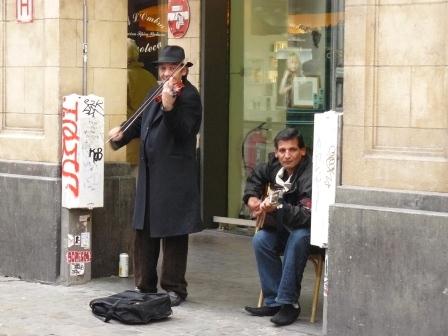
What cannot evade the eyes of tourists (even the richest ones, travelling by limousine) in the European capital is the number of beggars and homeless people.

With the exception of Bucharest, I haven’t seen as many beggars as in Brussels anywhere else in the world.

I didn’t see that many neither in London, nor in Paris, Berlin etc, and I hardly noticed any in Washington, DC.

One wouldn’t see beggars (only protesters – but that’s a different matter) near the White House, (Washington, DC) or Buckingham Palace (London).

Nevertheless, they are omnipresent near the European Commission (pics 3, 6), the European Parliament (pic 9) and Justus Lipsius building of the EU Council (pic 1).

They are not the ingenious street buskers seen in other cities but relatively lousy players (= beggars) who wish to have their ‘performances’ rewarded by passersby.

As long as all important companies want to be seen in Brussels and try to have a say in the intricate EU legislative process, why wouldn’t the begging industry do the same?!

The saddest thing is that many of these destitute people – its arguable if begging is profitable or not – use Romanian to swear at photoholics like me :-(

[For all the posts on this blog go to/Pentru toate postările de pe acest blog mergi la: Contents/Cuprins]

Monday, 12 December 2011

Hollow triumphalism [Triumfalism găunos]

In the wake of the last EU summit, all leaders who had entered lengthy negociations in Brussels claimed ‘victory’, whilst not truly achieving anything substantial for the half a billion European citizens.

On the one hand, the presumed Franco-German diktat of a European Fiscal Union stepped closer to reality than ever before.

By March 2012, another EU Treaty with as strong historical implications as those of the Treaty of Maastricht is due to be signed.

Out of the EU’s current 27 members (soon to be 28), at least 23 countries will no longer decide exclusively by themselves how to shape their national budgets. A Big – and pressumably wiser – Brother in Brussels (the European Commission) would ‘help’ national governments plan their spending more carefully.

That should be cheered as a ‘triumph’ of common sense and seen as a ‘safeguard’ that public debt would stop accumulating to unsustainable levels in EU countries, we were told.

Nevertheless, this assumption regarding the smooth functioning of the future United States of Europe (USE) does absolutely nothing to solve the actual economic crisis in Europe, and the future of the common currency is still uncertain.

Irrespective of the ideological debate – is it worth giving up national sovereignty or not, could Europeans live better within the USE than in their national states? – a full fiscal union offers no solutions to the current debt crisis…

Neither to the lack of competitivity of many European economic sectors or to the demographic and moral decline of the Old Continent.

When and who is ever going to address those issues in the EU? For how long would political leaders be fooled by fictions such as ‘economic growth’ and ‘prosperity’, which are impossible to achieve while built up on other fictions such as ‘credit’ and ‘capital markets’?

When will history makers (politicians) learn the bitter lessons of history that all times of severe crisis are the broader consequence of a grave moral ills rather than effects of mere disfunctionalities or redeemable mistakes?

There cannot be growth on a continent where millions of EU nationals are are still ‘second (or even fourth!) class citizenson the job market, where the brain drain to the USA has never ceased, where hedonism, promiscuity, moral relativism and abortions are widespread.

On the other hand, Britain’s PM David Cameron also claimed his petty ‘victory’ for managing to snatch his country out of the future new European treaty.

Far be it from me to join those deploring Great Britain’s self-condemnation to many years (the most commmonly invoked figure is 20) of isolation. After all, outside the European Exchange Mechanism and the Eurozone, Britain had done better than it would have probably done inside.

Anyway, the much esteemed financial services and the partly nationalised British banking system will not remain immune to what’s going on in the Eurozone, and their freedom of maneuver could be limited whether the UK is in or out a new EU treaty.

Cameron put himself in a ridiculous position, as defender of the bankers (and not for the first time!) in an era when everyone hates them, although most EU Council solutions to the crisis favoured this clique, not the European taxpayers.

In spite of being portrayed as an isolationist (in Europe) or foolish (at home), he dared taking a huge gamble, and that’s somewhat admirable.

Especially when compared to yesmen like Romania’s President Traian Băsescu, who has been a brainwashed lobbyist for the USE even long before this last EU summit.

Last, the little victories of the Hungarian, Swedish and Czech delegations who said they would first consult national parliaments are also ridiculous. It’s not impossible but very unlikely that they would join Britain on the isolationist path.

Britain and Sweden could possibly afford it, like Switzerland and Norway. But Hungary and the Czech Republic would eventually give in to unbearable pressures.

All the triumphalism of those pretending to avoid a catastrophy either by wowing for deeper European integration or, on the contrary, by staying out of too much integration – is equally meaningless.

Europe is in desperate need of both sound economic solutions and of reshaped moral foundations, which it gravely lacks.

Their absence is by no means a sign that the Old Continent requires a ‘revolution’ in political terms or a sort of ‘Nuremberg trial’ for a failed generation of bankers and/or politicians.

It would actually need other Europeans – people aspiring towards what truly matters in this life (which is but an antechamber of afterlife), not hordes of hedonist copycats, enslaved by the dreadful illusion that happiness equals a perpetual ‘I-do-what-I-please (having fun, feeling good) here and now’...

Simply replacing a wrong ideological model (unrestricted free flow of capital, living on credit) with another (a centralisation of austerity) leaves little room for hope. Everything will keep turning from bad to worse.

[For all the posts on this blog go to/Pentru toate postările de pe acest blog mergi la: Contents/Cuprins]

Friday, 25 November 2011

[EN] Hail to competing sites / [RO] Salutări siteurilor concurente (18)

[EN] A blog that thrashes the Eurozone (EMU) and everything that an be deemed good in regard to the EU is one kept by this Irish journalist from Brussels. [RO] Un blog care chelfăneşte Eurozona (EMU) şi tot ceea ce poate fi considerat bun în legătură cu UE este ţinut de această jurnalistă irlandeză din Bruxelles.

[EN] Hosted by the conservative and euroskeptic The Daily Mail, the blog has no mercy for pro-EU European leaders. [RO] Găzduit de conservatorul şi euroscepticul The Daily Mail, blogul nu are milă pentru liderii europeni pro-UE.

[EN] In the author’s view, for everything bad in Greece, Ireland, Spain, Portugal or Italy it’s surely the EU’s fault… [RO] În opinia autoarei, pentru tot răul din Grecia, Irlanda, Spania, Portugalia sau Italia este în mod sigur vina UE…

[EN] Enjoying less success than such a blog are the European Commission’s efforts (here, here, here) to defuse the myths and rumours about the EU. [RO] Bucurându-se de mai puţin succes decât un astfel de blog sunt eforturile Comisiei Europene (aici, aici, aici) de a dezamorsa miturile şi zvonurile despre EU.

[EN] Of which the Brit newspapers (especially but not exclusively) are filled with, often on a daily basis. [RO] De care ziarele britanice  (în special, dar nu exclusiv) sunt pline, adesea zi de zi.

[EN] Where does the truth lie? That’s for my readers to figure out for themselves! [RO] Unde se află adevărul? Cititorii mei să-l descopere singuri!

[For all the episodes of this series, and all the posts on this blog go to/Pentru toate episoadele din această serie şi toate postările de pe acest blog mergi la: Contents/Cuprins]

Wednesday, 6 July 2011

Witty bits from what I learned in the UK (19) [Vorbe de duh din ce am învăţat în UK]

I may have been surprised by the number of French people living in London, although not by their presence; I knew they were ‘supposed to be there’ at least since the time of the Huguenots, if not since… William the Conqueror, that is the year 1066 :-)

That was what I equally believed about Arabs, Jamaicans, Indians, Bangladeshis, Pakistanis, (as former subjects of the British Crown), ChineseItalians (who are usually everywhere in the world)… and, of course, Greek Cypriots.

What I had completely ignored was the possibility to meet as many Turks as I did, who actually form an entire… Turkish London – a community made up of some 70,000 people (oficially) or up to 400,000 (unoficially).

Many still contest the Turks’ commitment to democratic values in the Western world acception, however, one could hardly have anything to say against their entrepreneurial spirit which is perfectly compatible with the ‘free economy’ professed by the UK.

Just like Ernst Hemingway said that in every port in the world, at least two Estonians can be found, there probably is a small Turkish business in any British city, although the bulk of the Turkish Community lives in London.

Another surprise was to realize how many foreigners are working for think-tanks and other NGOs dealing with European Affairs. Out of those we met as Chevening Fellows, one was French, one German, one Italian, and one we didn’t get to meet was… Swedish.

Does this mean that ‘purebred Britons’ are uninterested in the EU? It’s hard to tell… But I couldn’t hide the fact that I sometimes I got this impression, in spite of also meeting some staunch British supporters of the EU, both in London and Edinburgh. One was a former Tory MEP.

I don’t know how effective Turkish Lobbyists are in Britain (+ at the EU level), compared to the well-established Turkish Lobby in the USA.

It is nonetheless very interesting that all Her Majesty’s (successive) Governments supported and keep supporting Turkey’s Accession to the EU, a stance that puts Britain at odds with Germany, France, Austria & other European countries.

This state of facts makes me wonder and ask my readers – if any of them could be familiar with such issues – the following:

Of all the ethnic groups living in London, which is the most influential? Has any of these communities succeeded in influencing British politics?

Apart from the lovely English language, around 300 other tongues are spoken in this Modern Babylon. Is any of these heard louder than others at Downing Street 10?

Do immigrant communities count in London like, say, in New York? Because as much as New York seems so different from the rest of the USA, so does London ‘feel’ (not necessarily look) differently from the rest of the UK.

[For all the episodes of this series, and all the posts on this blog go to/Pentru toate episoadele din această serie şi toate postările de pe acest blog mergi la: Contents/Cuprins]

Wednesday, 1 June 2011

Witty bits from what I learned in the UK (18) [Vorbe de duh din ce am învăţat în UK]


It’s been over a year since the most tangible (and some of the most cherished I assume) European Integration project, the Euro, started to look threatened.

Half a year after the Greek bailout (May 2010) came the Irish bailout (November 2010), and another half a year later came the Portuguese bailout (May 2011). What will happen in the next six months?

The Eurozone appears to have run out of ‘weak links’ whose default and even exclusion from the EMU would not be altogether catastrophic but somewhat bearable.

There are now fears of a next (bigger, biggest?!) global financial crisis. And it could well start with the solvency problems of the weakest euro-giants: Spain and Italy.

To some, the question is when the EMU will eventually prove to be an utter failure. To others, what thay are speculating about is how this imminent break-up would be possible, and to what degree.

Will it be a complete return to the the 1990s, with all euro-countries turning back to their national currencies? Or will it rather be a contraction of the Eurozone, scaled back to a core of the most efficient economies that make it up today?

Finally, there are the others – equally narrow-minded as those who rejoyce what they think is the demise of the EMU, because of its insolvent members.

They are the fanatics who insist that “there is no plan B,” therefore the current monetary union ought to survive ‘no matter what’. That is no matter what misery could bring to some countries that should have been part of the EMU in the first place.

There’s no reason to be happy about the prospect of seeing the Euro scrapped as a failed historic experiment, while are also no sane reasons to hold on to the ‘no matter what’ position.

Both the consenquences of giving up the Euro and of trying to preserve the Eurozone as it is today appear to be nothing but disatrous.

Europe and the EU will have to change, irrespective of what happens to the common currency now used in 18 EU states (+ colonies and some non-EU countries).

The turmoil within the EMU spares no country of ripple effects, and – to a certain extent – the fate of the entire ‘civilised world’ as we know it today depends on the ‘fate of the Eurozone’.

Countries like the UK, with it’s GBP, will have slightly more freedom of maneuver, unlike the Euro-slaves tied to decisions taken in Brussels and Frankfurt. However, not even China, Russia, Japan, nor the USA will be spared of what is due to happen on the Old Continent.

The Age of Discovery, two World Wars, problems in the Middle East (and in other former European colonies), almost every world event had and has to do with Europe. And now – with the Euro.

Before anything else, one big question should be: what will happen to Germany? How will this great nation cope with the break-up of the EMU, assuming that a ‘reduced Eurozone’ (to 10-12 countries, instead of 17) wouldn’t be such a cataclysm?

It’s worth rasing this question, because here’s another ‘witty bit’ that I learned in the UK, from a British economic analyst (married to a German woman :-).

Considering that For the past 400 years, all wars in Europe were fought because of German rise to supremacy on the continent,” he described the Eurozone as being “the best way to deal with German hegemony.”

What will we Europeans do if this ‘best way’ will no longer be to hand? Will we have to return to the old ‘worst ways’ in dealing with the strongest nations on the continent?

It’s very likely that those who were not good at playing by the EMU rules won’t be good at ‘alternative ways’ for keeping the statu quo in Europe either :-(

What if all these that we take for granted now – six decades of peace, freedom of movement, European cooperation – were taken away from us? Without all these, even a silly ‘cucumber war’ could lead to a Third World War, couldn’t it?

[For all the episodes of this series, and all the posts on this blog go to/Pentru toate episoadele din această serie şi toate postările de pe acest blog mergi la: Contents/Cuprins]

Saturday, 29 January 2011

A joke about Germany’s supremacy in Europe [O glumă despre supremaţia Germaniei în Europa]


Germany’s economic supremacy in today’s Europe (EU and EMU respectively) may not be anything to joke about. It’s a sheer fact.
.
No matter how much the Perfidious Albion, France, Poland or Romania would be whining about it, there’s only one economic superpower in the EU.
.
The topic is very interesting and – God willing – I would like to write more about it in 2011, especially as the ‘EMU crisis’ (or ‘euro crisis’, or whatever… – but still a ‘crisis’) is far from over.
.
Until then, here’s an interesting joke that could well be about... Germany’s lobby in Brussels. And let us ignore for a while that the German language is in not position of challenging the supremacy of English yet.
.
However, the joke (I thank a fellow blogger for sending it to me) it’s not completely far-fetched, as it may seem to some.
.
It makes an interesting analogy to how Germans know how to have things ‘done their way’ within the EU. They many not have Hitler’s Wehrmacht, but their economy is as strong today as it has ever been for the past two hundreds of years.
.
Enjoy the joke (+ my not-so-spectacular pics from Berlin), and keep an eye on Germany! I’d say it’s too early to dismiss this country’s potential on the world’s stage.
.
We’d better try to understand more this of country, and even learn German!
.
Even before learning Chinese, I’d say that any European country not having at least several ‘platoons of intellectuals’ who could speak perfect German and perfect Russian has a severe handicap. Only God can spare that country of the cost of such ignorance!
.
--- --- --- --- --- --- --- --- --- --- --- ---
.
“Euro-English”
(nothing but a joke, but bearing a ‘seed of truth’ like every joke :-)

.
The European Commission has just announced an agreement whereby English will be the official language of the EU rather than German which was the other possibility.
.
As part of the negotiations, Her Majestys Government conceded that English spelling had some room for improvement and has accepted a five year phase-in plan that would be known as ‘Euro-English’.
.
In the first year, ‘s’ will replace the soft ‘c’. Sertainly, this will make the sivil servants jump with joy. The hard ‘c’ will be dropped in favour of the ‘k’. This should klear up konfusion and keyboards kan have 1 less letter.
.
There will be growing publik enthusiasm in the sekond year, when the troublesome ‘ph’ will be replaced with ‘f’. This will make words like ‘fotograf’ 20% shorter.
.
In the 3rd year, publik akseptanse of the new spelling kan be ekspekted to reach the stage where more komplikated changes are possible.
.
Governments will enkorage the removal of double letters, which have always ben a deterent to akurate speling.
.
Also, al wil agre that the horible mes of the silent ‘e’-s in the language is disgraseful, and they should go away.
.
By the fourth year, peopl wil be reseptiv to steps such as replasing ‘th’ with ‘z’ and ‘w’ with ‘v’. During ze fifz year, ze unesesary ‘o’ kan be dropd from vords kontaining ‘ou’ and similar changes vud of kors be aplid to ozer kombinations of leters.
.
After zis fifz yer, ve vil hav a reli sensibl riten styl. Zer vil be no mor trubl or difikultis and evrivun vil find it ezi to understand ech ozer.
.
Ze drem vil finali kum tru! Und ve vil al be speking German lik zey vunted in ze furst plas!
.
[For all the posts on this blog go to/Pentru toate postările de pe acest blog mergi la: Contents/Cuprins]