Showing posts with label Cars the Brits Drive. Show all posts

Friday, 5 October 2012

UK’s motor vanity fair (28) [Bâlciul deşertăciunilor cu motor din UK]

A motor masterpiece made in Britain (Gaydon, England).


In a factory owned by a company from India (Tata Motors).


Registered in the very small Canton of Zug, Switzerland.


And photographed on a rainy day in Romania.

[For all the episodes of this series, and all the posts on this blog go to/Pentru toate episoadele din această serie şi toate postările de pe acest blog mergi la: Contents/Cuprins]

Friday, 10 August 2012

UK’s motor vanity fair (27) [Bâlciul deşertăciunilor cu motor din UK]

We’re all more or less familiar, from countless Hollywood productions, with how American police cars look like.

Who wouldn’t remember the TV series (especially of the 1970s, 1980s and 1990s) in which ‘good guys’ were chasing the ‘bad guys’ in cars like these?

It often took incredibly many police cars – crashed into one another, blown up, thrown over bridges etc – to catch the ‘bad guys’, didn’t it?

Actually, there have been so many movies (+ video games), that I bet we could find enough fan(atic)s able to identify which car is which without ever setting foot in America.

How about British police cars? Well, these few pictures can offer a glimpse on how they look like to anyone interested.

Not that there wouldn’t exist (here’s an example), but I personally don’t remember any British film with police cars involved in chasing criminals. James Bond movies are a different matter…

Therefore, I had no particular expectations in regard to British police cars, although I had seen with my own eyes that in New York, these vehicles really do look like in movies!

To be honest, I found these Brit cars completely unspectacular and somehow incapable of conveying the same impression of authority that American police cars bear.

Maybe there’s a political correctness directive that imposes police cars to look friendlier (like a plumber’s car or an ice cream van?!), instead of looking too intimidating?!

[For all the episodes of this series, and all the posts on this blog go to/Pentru toate episoadele din această serie şi toate postările de pe acest blog mergi la: Contents/Cuprins]

Friday, 18 May 2012

Chestii d-astea, numai la britanici (34) [Things like these, only at the Brits]

Că taxiurile britanice sunt mult mai viu colorate decât apar în filme – când, probabil, numai cine plăteşte bani grei poate apărea pe portierele automobilelor Manganese Bronze care apar pe marile şi micile ecrane – am mai scris deja (aici şi aici).

Dar o reclamă cu totul neobişnuită este cea din imaginea de faţă, făcută în Edinburgh. Oare mai există altundeva în lume astfel de invitaţii pentru a urma studii universitare (în speţă la Aberdeen, în nord-estul Scoţiei)?!

Ce efect o fi avut campania aceasta?! Câţi tineri or fi socotit că această bătrână (datând din 1494) University of Aberdeen trebuie să fie una ‘cool’, din moment ce îi întreabă “Ce mai aştepţi? …un autobuz?” şi îşi face reclamă în acest mod inedit?

[Pentru toate episoadele din această serie şi toate postările de pe acest blog mergi la/For all the episodes of this series, and all the posts on this blog go to: Contents/Cuprins]

Tuesday, 15 May 2012

UK’s motor vanity fair (26) [Bâlciul deşertăciunilor cu motor din UK]

Again, I find no point in saying much; here’s another extremely interesting spyder photographed by my reader C.L., which was parked to the left side of this one.

To my great surprise, quite soon after I had posted the previous episode of this series, someone correctly identified the car brand. Would this happen again?

I couldn’t identify the symbol on the – let’s thank Wikipedia for the short English lesson! :-) – bonnet ornament (or radiator cap or motor mascot or car mascot) in the pic.

[For all the episodes of this series, and all the posts on this blog go to/Pentru toate episoadele din această serie şi toate postările de pe acest blog mergi la: Contents/Cuprins]

Saturday, 28 January 2012

UK’s motor vanity fair (25) [Bâlciul deşertăciunilor cu motor din UK]

A strange looking car photographed by my reader C.L., I-don’t-know-where in the UK, inside what seemed to be (from other pictures) a sort of exclusive little scrapyard, as it is known in British English.

Or, if any one is more familiarised with the name in American English – a junkyard. A place where a bunch of former fancy cars – spyders (or roadsters by their American name) – had been put to rest (or to rust :-).

This carmine (do I correctly identify the colour, girls?!) car appears to me as one that has once been some mighty ‘king of the roads’, maybe in the 1960s or 1970s. But I’ve got no idea about the brand.

To any reader from anywhere in the world ever landing on this blog page (and being better informed about this car that I am, of course) I can only say: please, share your knowledge with us!

[For all the episodes of this series, and all the posts on this blog go to/Pentru toate episoadele din această serie şi toate postările de pe acest blog mergi la: Contents/Cuprins]

Tuesday, 20 December 2011

UK’s motor vanity fair (24) [Bâlciul deşertăciunilor cu motor din UK]

Although I dedicated another episode to this legendary British car, I feel that there’s a little more to say before exhausting (or maybe not?!) the topic.

In tune with the season, these images (taken by my reader C.L.) are meant to illustrate the good news of 2011 for England’s motor industry.

The Chinese owners of MG have kept their word, and seem more determined to succeed than the previous German owners (BMW).

Not only that they reopened a former MG plant in Birmingham, yet the result of their work could be seen on British roads as of April 2011.

The (re-named) ‘Modern Gentleman’ is back. A new model (MG6 1.8T Fastback) was launched in spring, for a starting price of £ 15,495.

Obviously, many could argue that this ‘renaissance’ of the motor industry in Britain is rather symbolic, having a negligeable impact (whats more fragile than air bridges? :-) on the whole of UK’s economy.

Over 75% of the ‘new MG’ is build in Shanghai, shipped to Britain, and finished by less than 100 skilled British specialists.

Anyway, irrespective of the adverse global economic climate, why wouldn’t we hail any little success, in this world so flooded with bad news about the automotive industry?

It took 16 years for the brand’s fans (some of their car clubs: here, here and here) to see a new MG and their patience was rewarded.

There are less than 10 years since no new ARO left the assembly plant in the Romanian municipality of Câmpulung-Muscel, Argeş county (AG).

MG has always been an elitistic brand, such as it’s birthplace (Oxford) is. Still, we are witnessing its resurrection.

Would it be so exaggerate to dream that ARO – a ‘SUV for the masses’, exported to over 110 countries – could be reborn thanks to its current British owner of Romanian descent?

[For all the episodes of this series, and all the posts on this blog go to/Pentru toate episoadele din această serie şi toate postările de pe acest blog mergi la: Contents/Cuprins]

Friday, 21 October 2011

UK’s motor vanity fair (23) [Bâlciul deşertăciunilor cu motor din UK]

Apart from a brief trip to Berlin (some pictures of it on this blog), I didn’t have the chance to know how German cars ‘fit’ into the landscape of German cities.

However, I must say that they surely fit on the streets of an elegant British city like Edinburgh  where I saw hundreds of them and I wish I knew why most were either black or grey?! :-)

While even an iconic brand like the Mini is produced under German management (+ technical leadership, I presume), there’s no doubt that Brits love German cars.

Just like Americans who – irrespective of their patriotism requiring them to give a helping hand to their national car manufactures – keep buying German and Japanese brands.

The same ‘love story’ between motorists and German cars can be witnessed in Eastern Europe, although, with some typically ‘Oriental’ features.

In several countries neighbouring the EU, these cars are stolen from richer countries like some men used to kidnap their wives some no longer than a century or so ago.

Then, most of these cars are second hand vehicles, nevertheless, sometimes considered better than brand new cars like Dacia.

And there’s one more peculiarity of these cars – they are quite often driven by a particularly kind of people, the ‘manelists’, devout listeners of ‘manele’.

[For all the episodes of this series, and all the posts on this blog go to/Pentru toate episoadele din această serie şi toate postările de pe acest blog mergi la: Contents/Cuprins]

Friday, 23 September 2011

[EN] No comment / [RO] Fără comentarii (16) – BMW Obsession / Obsesie BMW

[EN] BMW – a German probably as loved in the UK (pics 1 + 4) as it is in Romania, at least according to what I could see. [RO] BMW – o maşină germană probabil pe atât de iubită în UK (pozele 1 + 4) precum şi în România, cel puţin din ce am putut vedea.

[EN] Indeed, Britons have some big BMW car clubs (+ here, here, here), but they seem far from the ‘BMW obsession’ from Romania. [RO] Într-adevăr, britanicii au nişte mari cluburi auto BMW (+ aici, aici, aici), dar par a fi departe de ‘obsesia BMW’ din România.

[EN] In the 2nd pic: a BMW-inspired urban ‘work of art’ in Bucharest. [RO] În cea de-a 2-a poză: o ‘operă de artă’ urbană din Bucureşti inspirată de BMW :-)

[EN] In the 3rd pic: an old Romanian Dacia tuned up with a BMW bonnet.*** [RO] În cea de-a 3-a poză: o veche Dacie românească tunată cu o capotă de BMW :-)

*** [EN] NOTE: ...as Britons call it, while Americans say ‘hood’. [RO] NOTĂ: ...cum o numesc britancii, iar americanii îi spun hood’.

[For all the episodes of this series, and all the posts on this blog go to/Pentru toate episoadele din această serie şi toate postările de pe acest blog mergi la: Contents/Cuprins]

Friday, 8 July 2011

[EN] No comment / [RO] Fără comentarii (12) – To speed and to die / A goni şi a muri


[EN] An interesting photographic metaphor of my reader C.L., whether it was taken on purpuse or not: [RO] O interesantă metaforă fotografică a cititoarei mele C.L., fie că a fost făcută intenţionat sau nu:

[EN] Sports cars (worth at least £ 50,000 each, I guess) next to a graveyard. [RO] Maşini sport (valorând măcar £ 50,000 fiecare, socot eu) lângă un cimitir.

[EN] This is the final destination of excessive speed, as well as that of vanity, ambition, earthly dreams,  pleasures… [RO] Aceasta este destinaţia finală a vitezei excesive, precum şi a vanităţii, ambiţiei, viselor pământeşti, plăcerilor…

[For all the episodes of this series, and all the posts on this blog go to/Pentru toate episoadele din această serie şi toate postările de pe acest blog mergi la: Contents/Cuprins]

Thursday, 16 June 2011

UK’s motor vanity fair (22) [Bâlciul deşertăciunilor cu motor din UK]

It goes well with exclusive golf courses, with luxurious mansions, with holding stocks or a top management position in the banking industry, with nobiliary titles and generally with a “I-am-not-an-ordinary-mortal” attitude.

It’s… Aston Martin, the oldest sports car maker (1914). Another iconic brand of the UK, produced in Gaydon, Warwickshire (West Midlands, England).

Only 5,000 such vehicles were sold in the world in 2010 (down from a peak of 7,300 cars in 2007) yet, despite problems of other British car manufacturers and the entire global automotive industry, the company is thriving.

As the economic crisis makes billions of people poorer, the few prospective buyers get richer, so that Aston Martin expects that 25% of its sales will come from Asia by 2016.

[For all the episodes of this series, and all the posts on this blog go to/Pentru toate episoadele din această serie şi toate postările de pe acest blog mergi la: Contents/Cuprins]

Thursday, 10 March 2011

UK’s motor vanity fair (21) [Bâlciul deşertăciunilor cu motor din UK]

I bet that most people – some 99% of the ‘first-time-visitors’ as I once had been myself – have a different mental image of British taxis than the one they get pretty soon after arriving in Britain.

Because of films, postcards, English books and even toys and souvenirs, we learn that ALL British taxis MUST be painted in a shiny but austere shade of black.

Few things could be as wrong as this false image that prospective tourists have! But it’s fun to realize how wrong you were…

As a matter of fact, although most typically British taxis are black (like those in the 2nd, 3rd & 6th pics) when they come out of the factory gate, many of them are eventually covered up in advertising images.

Obviously, most are black. However, some are white – even white + turquoise as those in Brighton (9th pic) –, others are maroon, (1st pic, by my reader C.L., as well as the 6th) and some can exceptionally be… yellow (8th pic).

Many others are lively coloured, thanks to a booming (or was it just before the economic crisis?!) taxi advertising industry.

Consumers’ can easily switch from one TV/radio channel to another, but while they are on the street not only that they can’t avoind seeing these cars.

Looking at them can happen to be a nice experience, especially in a typically British rainy day, when there aren’t many lively colours to notice around.

Not only Irn-Bru, but almost everything else (products, services, events etc) is advertised on British black cabs, making these cars some kind of ‘tourist attraction’ in themselves.

Maybe not all British taxis are made by the national car maker Manganese Bronze – kept alive thanks to foreign capital, coming from China’s Geely – but they make surely up an ‘iconic brand’ of Britain and they are the most visible in big cities.

[For all the episodes of this series, and all the posts on this blog go to/Pentru toate episoadele din această serie şi toate postările de pe acest blog mergi la: Contents/Cuprins]

Sunday, 16 January 2011

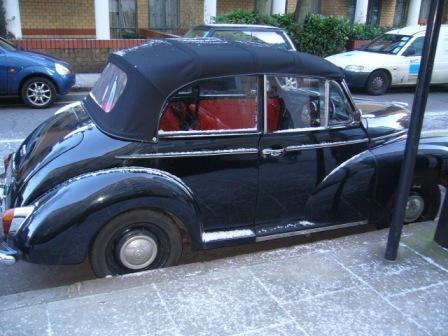
UK’s motor vanity fair (20) [Bâlciul deşertăciunilor cu motor din UK]

Enthusiats consider it a ‘British miracle’ and it must have been so, in 1948, when this economy car took to the British roads. Eventually, as “video killed the radio star,” so was this car of a slower-paced age killed by cars more suitable to the current maddeing faster times.

The ‘miracle’ only lasted up to 1958, when production stopped, although commercial variants kept being produced until 1971. A Total of 1,6 Morris Minor vehicles were build, but I don’t think that more than a few thousands are still in circulation.

Thanks to my reader C.L., I can add these lovely pictures of a Morris Minor to those that I took myself, and which illustrate the first episode of this series. They are glimpses of mid-20 century Britain, and offer a good example of British craftsmanship.

In the popular imagination the Morris Minor is the car of schoolmasters, district nurses, midwives, openly Anglican vicars, helpful rural grocers and men wearing hats who are, generally, not in a hurry.

If the staid institution of English afternoon tea were motorised, it would look like this. The Minor is a symbol of a gracious England unspoiled by sodium lights, bypasses, tower blocks, KFC and greedy consumerism.

This England was a fable maybe, but fables are often more interesting than facts.” – this is how The Daily Telegraph praises the car pictured here, often seen as ‘quintesentially English’ or ‘typifying Englishness’.

[For all the episodes of this series, and all the posts on this blog go to/Pentru toate episoadele din această serie şi toate postările de pe acest blog mergi la: Contents/Cuprins]